


No Doubt - Tragic Kingdom

Written by: Moti Kupfer
Release date - 10.10.1995
Joseph Campbell, the American thinker and writer, argued that we must be willing to let go of the life we have planned in order to embrace the life waiting for us.
That idea beautifully captures the journey of an obscure ska band from Anaheim, California. Radio stations ignored them, and one programmer famously suggested that only divine intervention could get them on the air. Yet they would go on to release an album that sold around 16 million copies worldwide.
This is the story of "Tragic Kingdom", the third album by "No Doubt", released on October 10, 1995.
It is the mid-1980s, and keyboardist Eric Stefani enters himself and his sister, Gwen Stefani, in a school talent show in Anaheim, California. Their song of choice is "On My Radio", the 1979 hit by ska band "The Selecter".
Gwen wears a homemade dress modeled on the one Julie Andrews wore in "The Sound of Music", her favorite musical.
It is the starting point for the siblings' musical adventure. In 1986, they form a band with John Spence, their coworker at the American fast-food chain "Dairy Queen".
Spence's habitual expression, no doubt, inspires the band's name. He shares vocal duties with Gwen, adding his rough-edged voice to hers.
Inspired by British ska bands such as "The Selecter", "Madness" and "The Specials", the members of "No Doubt" give their everyday frustrations a musical outlet.
Feeling trapped in sun-drenched Orange County, home to Disneyland, they begin playing local parties and quickly build a following. Along the way, bassist Tony Kanal joins the band and soon begins secretly dating Gwen.
But tragedy strikes in 1987, when Spence takes his own life. It is the first of three upheavals that will change the course of "No Doubt", a band whose future will become inseparable from its personal dramas.
After Alan Meade, the trumpeter who had become a co-lead vocalist, leaves "No Doubt", Gwen is ready to front the band on her own. By 1990, the lineup has taken shape with drummer Adrian Young and local metal guitarist Tom Dumont, both fans before becoming members, alongside a strong horn section.
Their popularity in Southern California's clubs and colleges grows until they catch the attention of Tony Ferguson, a talent scout at "Interscope". He brings renowned record executive Jimmy Iovine to a "No Doubt" show. Iovine predicts that the girl will be a star within five years. How right he turns out to be.
For the moment, though, "No Doubt" has a difficult start at Interscope. Their debut is a cabaret-flavored ska-pop album, written largely by Gwen's brother Eric, at a time when grunge reigns supreme.
Poor sales make Interscope hesitate over a follow-up. The label takes a firmer hand in shaping the band's sound, particularly through the new producer it assigns them, singer Matthew Wilder. Who remembers his "Break My Stride"?
Eric dislikes the arrangement and gradually withdraws from the band, even though rehearsals take place at his house. After leaving in 1994 to work as an animator on "The Simpsons", he leaves the other members to take on the songwriting responsibilities.
Around the same time, bassist Tony ends his seven-year relationship with singer Gwen. Until then, Gwen has little experience writing lyrics, but the difficulties of those years suddenly leave her with an enormous reservoir of pain.
She is confused and disappointed, unable to understand why the men in her life seem to be leaving her all at once. In many ways, she has traditional values. In interviews from the period, she expresses surprise at having joined a band and become famous when her natural inclination had been to start a family.
Some of her songs express that longing for a simple life. They evoke a modest young woman raised with a clearly defined future in mind. Yet that impression is misleading, nowhere near an adequate account of the desires and growing independence of a forceful woman who proves, throughout the album, that vulnerability and strength can coexist.
Our first encounter with "Tragic Kingdom" comes through "Spiderwebs", an exhilarating song about a woman screening calls from a man who keeps pestering her.
A real caller inspired it. Gwen explained that she had always had a boyfriend, so she had never needed to deal with men trying to ask her out.
She recalled giving her number to a man who would call in the middle of the night and try to sing to her or play acoustic guitar over the phone for fifteen minutes. She had no idea how to make him stop.
According to Tony, he and Gwen were trying for something in the spirit of "Blondie"'s cover of "The Tide Is High", with a change in tempo between the introduction and the main section. The chorus, asking callers to leave a message and promising to call back, later became a popular answering-machine greeting.
An interesting detail: in the United States, "Just a Girl" was the only track from "Tragic Kingdom" released as a commercial physical single. Other songs went to radio and appeared as singles in other markets, but if you wanted to buy "Spiderwebs" in the US, you had to buy the whole album.
On "Excuse Me Mr.", Gwen presents the opposite of the assertive woman in "Spiderwebs", actively trying to capture a man's attention.
According to Tony, the original version was softer and more melodic, but the band preferred the harder arrangement. "No Doubt" disagreed with producer Wilder, who wanted them to record a country-style version.
Adrian recalled that they had been playing the song with a heavier approach, but Wilder wanted something closer to a country shuffle, so they tried it.
They later decided they disliked his version. By then, however, their own arrangement had been erased from the tape, forcing them to return and record it again the way they were used to playing it.
The album's only US commercial physical single was, as mentioned, "Just a Girl". Gwen wrote it out of frustration with her father, who was overly protective of her while giving her brother Eric much greater freedom.
Gwen explained that she would not trade being a woman for anything, but that men did not understand how burdensome it could sometimes be. The song became an anthem of female empowerment, although that had not been her intention when she wrote it.
She was in a band with men, and all her friends were men. She wanted to write from that personal perspective, which she felt captured who she was better than anything else.
The video, directed by Mark Kohr, gave most fans their first glimpse of Gwen. It established her image in the minds of many young admirers who would try to emulate her.
Kohr was known for directing videos for bands such as "Green Day", including "Longview" and "Basket Case". He also directed videos for strong, self-assured female performers, among them Alanis Morissette's "Hand in My Pocket" and Shakira's "Ojos Así".
By the time the album came out, Gwen and Tony's relationship was already history. Several songs tell its story from her perspective, sometimes as the heartbroken partner and sometimes as an ex plotting the perfect revenge, as on "Happy Now?".
Tony wrote the music with guitarist Tom without fully processing that it was a revenge song aimed at him. That realization came later, when he heard it on the radio and the presenter introduced it as a pointed jab in his direction.
One of Gwen's earliest compositions was "Different People". In an interview, she explained that discovering songwriting had made her feel like a different person.
Before that, she had felt there was nothing she was particularly good at. Suddenly, she had something she cared deeply about. She remembered her father listening to their earliest recordings on his way to work, telling her they were good and encouraging her to keep going.
The song celebrates a wide variety of people coming together in a natural world full of wonders. A celebration of human diversity, it even appeared on Barack Obama's playlist for the 2012 election campaign.
Gwen described how strange and exciting it was to discover that one of her earliest songs had found its way onto the president's playlist.
On "Sixteen", she addresses teenagers and the anxieties of growing up. The opening riff differs from much of the album, leaning toward a more rebellious sound. A spoken interlude just before the guitar solo gives a knowing nod to young listeners who feel misunderstood.
One of the album's most beloved songs is "Sunday Morning", also released as its fourth single. Gwen sings about believing she knew her partner, Tony, so well, only to be taken by surprise when he left her. It is an upbeat song in which she looks back on that delicate situation with clarity and a measure of acceptance.
The song that follows, "Don't Speak", presents the same Gwen from the painful perspective of a former partner. She wrote it with her brother Eric before he left the band. Originally a love song, it became a song of heartbreak after Tony ended their relationship.
On "World Go 'Round", we step away from the album's central subject to look at the planet through a wider lens. Gwen sings about being so caught up in our own lives that we forget to appreciate what surrounds us, adding that it is time to take care of ourselves and the Earth before it is too late.
The definitive breakup song, "End It on This", again portrays a woman deeply in love with her partner who begins to realize that he does not share her enthusiasm. She decides to take matters into her own hands and end the relationship, knowing there is nothing left to salvage.
On the final track, we see how heartbreak can take many forms. It is angry, sad, confusing and tense, and Gwen throws it all in our faces.
The title track, "Tragic Kingdom", plays on Disneyland's Magic Kingdom nickname. Although its criticism is directed at the park itself, it can also serve as a metaphor for corruption in the wider world. The album takes its name from the unflattering nickname Tom's seventh-grade teacher gave Disneyland. Here, it reflects how the members of "No Doubt" see the world around them.
With 16 million copies sold worldwide by 2004, there is a good chance their view of the world has changed a little since then.
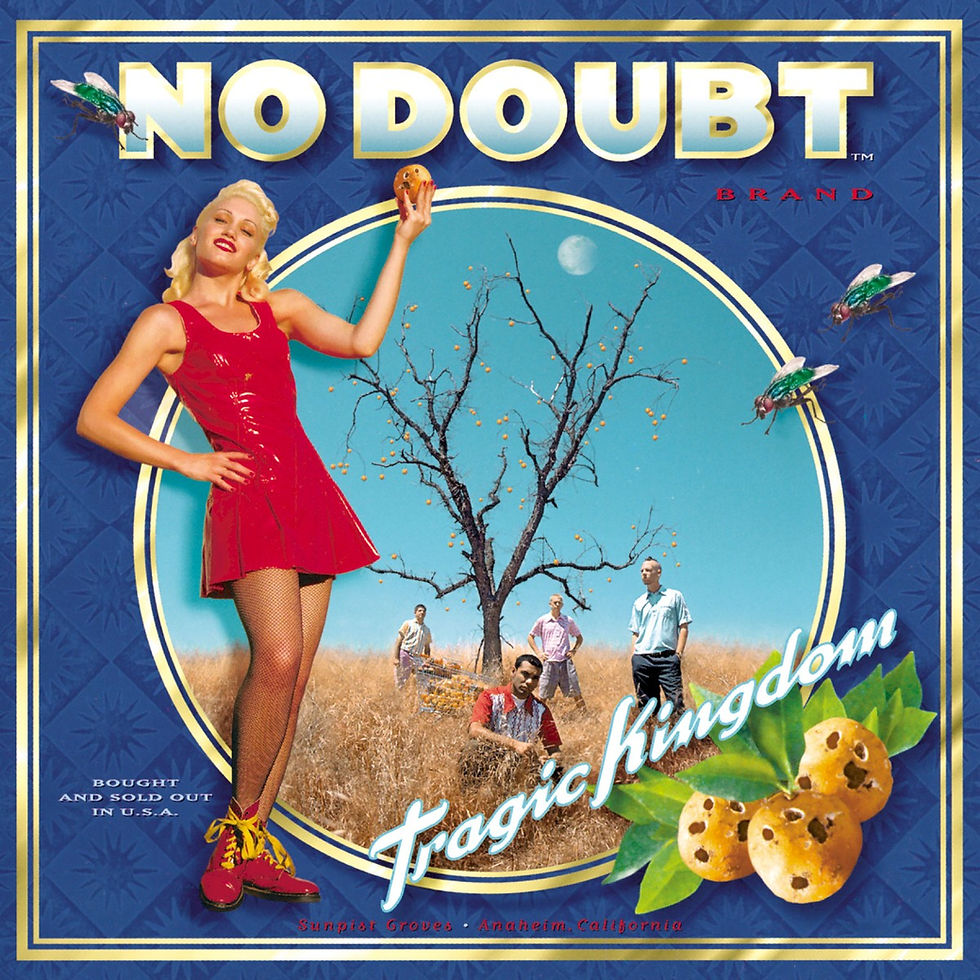
The album cover and portraits were shot by photographer and artist Daniel Arsenault. Gwen stands in the foreground in a red dress, while the other band members appear in an orange grove behind her.
The red dress Gwen wears on the cover was later loaned to the "Hard Rock Cafe" and subsequently displayed in an exhibition at the Fullerton Museum Center. Valued at $5,000, it was stolen from the exhibition in January 2005.
For Listening: Spotify, Apple Music
Face/Off - Israel's Rock Blog


Comments