


Depeche Mode - Playing the Angel

Writer: Moti Kupfer
Release date - 17.10.2005
Before their eighth album, "Songs of Faith and Devotion", Martin Gore admitted that "Violator" had been the last album the band had enjoyed making together.
Success had turned them into a stadium band, but the distance between them onstage was mirrored in the studio. Dave Gahan's move to the United States, his addictions and his brushes with death had changed something in him.
Gore also struggled with alcoholism, while Andrew Fletcher battled crippling anxiety. In 1993, Gahan suffered a drug-related heart attack, Gore experienced at least three stress-induced seizures, and Fletcher took several breaks from the band to look after his mental health.
In 1995, the same year Gahan attempted suicide, Alan Wilder left the band, and "Depeche Mode" seemed perilously close to the end.
But as the 1990s drew to a close, Gahan got clean and became a different person, more grounded and focused on the here and now. He suddenly realized that he, too, could write songs, and in early summer 2003 he released his first solo album, "Paper Monsters".
For Martin Gore, recovery was slower than it was for Gahan. In the meantime, their tenth album, "Exciter", had taken a half-step away from their established sound and drawn mixed reactions. Although it reached the top ten in both Britain and the United States, "Exciter" sounded like a band desperately in need of a break.
As mentioned, Gahan released an album during that break, while in April 2003 Martin Gore released his first full-length solo album, "Counterfeit²", following the 1989 EP "Counterfeit". As if that were not enough, in a series of interviews in 2004 Gahan appeared to mock Andy Fletcher's lack of musical input, telling one interviewer that the band no longer worked, just like the drugs.
Meanwhile, in an interview with "Rolling Stone", he seemed to issue Martin Gore an ultimatum: unless Gore was willing to let them both bring songs into the studio and support one another, Gahan saw no point in making another "Depeche Mode" album. At that point, he said, he no longer really cared.
Gahan was eager to gain a foothold in writing the lyrics, an area that had been almost entirely under Martin Gore's control. Gore, meanwhile, denied that he was some kind of totalitarian dictator and admitted, with a certain sadness, that Dave was talking to the press rather than to him.
It was therefore something of a surprise when the trio finally reunited in late 2004, agreeing that Gahan would contribute songs to the next album. Fletcher said that Dave's songs were now really good, perhaps in an effort to reassure him. In any case, if fans had feared the end, by early 2005 it was clear: "Depeche Mode" were heading toward their eleventh album, "Playing the Angel", released on October 17, 2005.
Recording began in early 2005 at "Sound Design" studios in Santa Barbara, with Ben Hillier appointed as producer. His previous work included "Think Tank" by "Blur", "People Are Expensive" by "Echobelly" and "Cast of Thousands" by "Elbow".
Unlike Mark Bell, the producer of "Exciter", Hillier was less interested in technology for its own sake and wanted a more organic sound. He explained that the previous album had been made on laptops, whereas he wanted the human element of a live performance, which led to the use of many analog instruments. For him, that human quality was what had been missing from the previous record.
Three songs on the album were written by Dave Gahan together with Christian Eigner and Andrew Phillpott, making this the first "Depeche Mode" album to feature his songwriting contributions, outside his solo career. It was also the first album since 1984's "Some Great Reward" on which Martin Gore had not written every song.
Lyrically, faith, sin, pain and suffering recur throughout the album. Gore explained that "John The Revelator" addresses faith while also condemning the idea of a God who punishes and damns.
The song draws on a traditional song of the same name recorded in the 1930s.
In an interview with a French magazine, Martin Gore explained that the song questions unquestioning religious belief and the image of a punitive God. He referred to the Book of Revelation, with its seven angels sounding their trumpets and unleashing plagues and floods that gradually destroy much of humanity, leaving only the true believers. Gore made it clear that he did not share that belief.
Gahan explained that "Suffer Well" grew out of a moment when a friend told him to suffer well, probably during his struggles with addiction in the 1990s. The phrase stayed with him.
At first, Gahan had not understood what this older, more experienced man meant. Why would anyone tell him to suffer well? Eventually he realized that the advice was about facing suffering and working through it: if he could do that, he could move on.
Another subject Gore addressed was his divorce. "Precious" was written about the way his children were coping with their parents' separation.
The song is a message to Gore's children, who were aware of the divorce. He felt guilty that they had to witness the process.
Recognizing their fragile state, Gore offers them sympathy but also acknowledges that things break, asking them to keep faith in both parents. Although it is a deeply personal song for Martin Gore, it was sung by the band's lead vocalist, Dave Gahan, as was standard practice for the group.
The second single, "A Pain That I'm Used To", is one of the relatively few "Depeche Mode" songs to feature a real bass guitar, played here by Andy Fletcher. Martin Gore recalled that getting the analog bass sound in the introduction right had been particularly difficult.
The album closes with "The Darkest Star", which contains the phrase that became the album's title, "Playing the Angel".
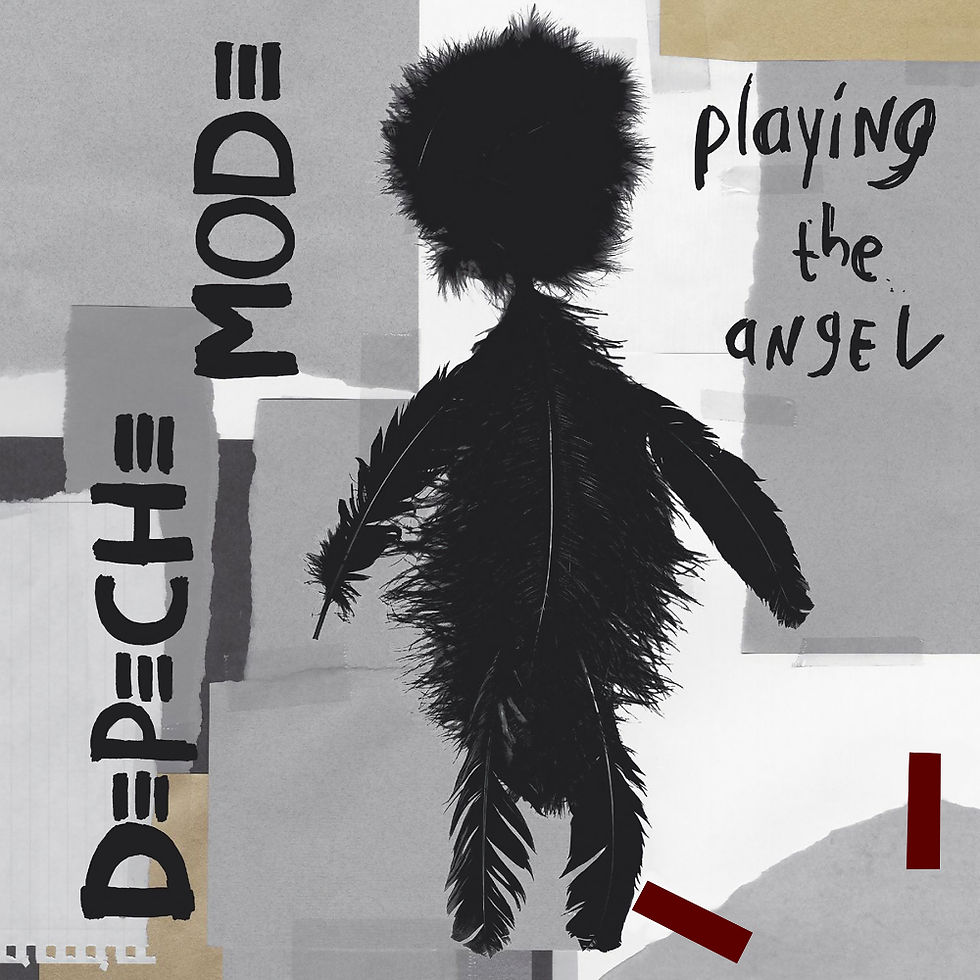
Designed by Anton Corbijn, the album cover is a black-and-white, sepia-toned image of a stylized bird with outstretched wings, recalling the artwork for the band's single "Personal Jesus". The back cover carries the phrase "Pain and suffering in various tempos". The imagery and title seem to reflect the album's themes of personal struggle and emotional maturity, shaped by Martin Gore's experiences at the time.
The album reached number six on the UK Albums Chart and number seven on the US Billboard 200.
P.S. The album's tour began on October 28, 2005, in New York and ended on August 1, 2006, in Athens, Greece. Its final show was supposed to take place on August 3 at "Hayarkon Park" in Israel, but the technical crew refused to travel there during the Second Lebanon War, leading to its cancellation. The announcement came just two days before the scheduled show.
For Listening: Spotify, Apple Music
"Face/Off" - Israel's Rock Blog


Comments