


Dennis Wilson - Pacific Ocean Blue

Written By: Moti Kupfer
Release date - 22.08.1977
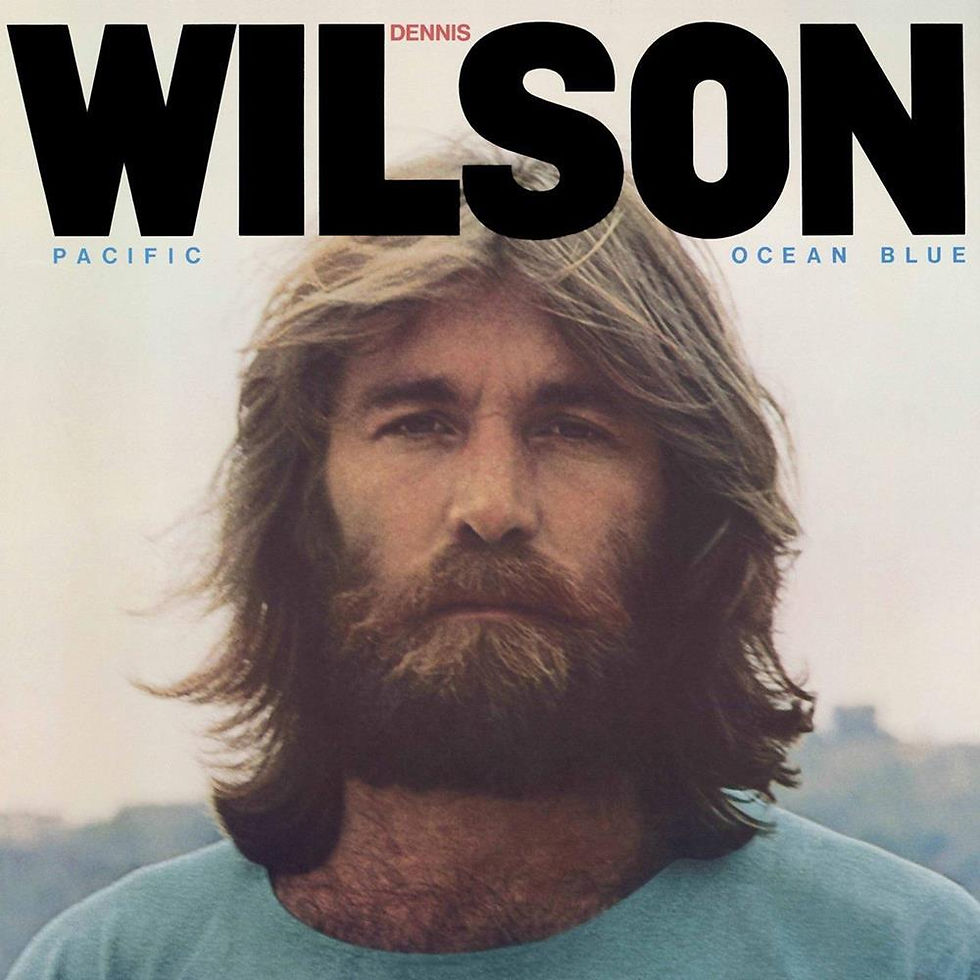
"One by one they would gather, long-haired and barefoot, dreaming together and flying, children of the moon, children of the moon, children of the moon, beautiful children." - Shlomo Yidov.
Dennis Wilson was, in many ways, one of those children of the moon, a free spirit and one of those beautiful young men with flowing hair. It was hardly surprising that women could not take their eyes off him, something that stirred jealousy in his brothers, especially Brian. Brian Wilson may have been the face and creative mind of "The Beach Boys", but at concerts it was often "Dennis! Dennis! Dennis!" that the girls screamed as they chased after him. Dennis, naturally, knew exactly how to take advantage of the attention and celebrate life in every possible sense.
He loved the good life, frequently got himself into trouble and seemed determined to live on the edge. They called him Dennis the Menace.
Dennis Wilson was never really given much of a chance to prove that he was a serious musician, either as a songwriter or as an instrumentalist. The Wilson brothers' mother insisted that Brian Wilson include Dennis in "The Beach Boys", and he joined the band as its drummer.
Fans did not expect much from him musically. Dennis was generally perceived as the handsome, hedonistic drummer who loved the good life rather than as an ambitious musician.
At times he was even replaced behind the drums by other musicians, but the enormous quantities of charm and charisma he brought with him were apparently everything "The Beach Boys" needed.
His adventurous nature eventually led him, horrifyingly, straight into the arms of his new friend Charles Manson. Manson, an ex-convict and frustrated musician who wrote songs that went nowhere, would later become a cult leader and murderer. At the time, however, his charisma fascinated Wilson, who allowed Manson and members of his "Family" to stay at his home for a period.
Before long, Manson began pressuring Wilson to use his music-industry connections to help him secure a recording contract. He was desperate to become a musician at almost any cost, and his relationship with Dennis became increasingly threatening. For Wilson, it eventually became one step too far. He distanced himself from Manson for good, but not before taking one of Manson's songs and transforming it into a "Beach Boys" recording of his own.
As Brian Wilson gradually withdrew, it suddenly became apparent that another Wilson brother was capable of filling at least part of the creative vacuum. Dennis began writing more seriously. Songs and musical ideas that had accumulated over the years slowly emerged from the drawer, and a process of writing, recording and artistic maturation that stretched across much of the 1970s eventually took shape as his first solo album, "Pacific Ocean Blue", released on August 22, 1977.
It is an album filled with hymns to the ocean and longing for it, like a ship that one moment drifts peacefully across calm water and the next is violently tossed from side to side. The songs reflect that same instability. "Pacific Ocean Blue" is a raw masterpiece that blends blues rock and psychedelia with shades of jazz and funky rhythms. Despite its rich instrumentation and the elaborate production created by Wilson and Gregg Jakobson, melancholy gently envelops almost every corner of the record. It seems to rise directly from somewhere deep inside Dennis, giving the album a painful emotional weight that becomes even more haunting in light of the self-destructive path that eventually led to his death in 1983, before he had even reached the age of 40.
The album opens with "River Song", in which Wilson expresses an intense desire to escape the city and find a simpler, more natural existence.
"Moonshine" explores intoxication, emotional turbulence and the fleeting nature of love and life. Musically, it begins with a few bars of melodic piano before expanding dramatically into a sweeping orchestral arrangement.
That emotional duality follows the album almost until its final moments. It can be heard in "Friday Night" and especially "Dreamer", which opens with funky electric piano and harmonica before moving into an arrangement colored by jazz.
Wilson wrote "Farewell My Friend" in memory of Otto "Pop" Hinsche, father of Billy Hinsche and father-in-law of Dennis' brother Carl. Otto had become a father figure and close friend to Dennis, and he died in Wilson's arms. Dennis later explained exactly how the song emerged: "My best friend died in my arms, and I came to the studio." He described the piece as "sort of a happy farewell", inspired partly by Otto's love of Hawaii.
There is something unbearably tragic about the fact that six years later "Farewell My Friend" would be played at Dennis Wilson's own funeral.
More than three decades after the album was recorded, an unexpected connection emerged between Dennis Wilson and "Foo Fighters" drummer Taylor Hawkins. Hawkins discovered "Pacific Ocean Blue" through Gregg Jakobson, Wilson's songwriting partner and co-producer, who was also the father of Hawkins' former girlfriend. Hawkins fell completely in love with the record. "I loved the honesty in it, the aching beauty of his songs and his voice," he later recalled. "It sounds like he's singing from a barstool." He became such an obsessive admirer that whenever he encountered a rare vinyl copy of the album, he bought it.
When the expanded reissue of "Pacific Ocean Blue" was being prepared in 2008, Hawkins was invited to provide vocals for "Holy Man", a track Wilson had worked on but never completed with a satisfactory lead vocal. Jakobson had long heard a similarity between their naturally rough, gravelly voices, and Hawkins himself felt a genuine connection to Dennis. As he explained: "I'm a beach kid, a drummer, and I've been living with Dennis's music for a long time."
Hawkins approached the task with considerable hesitation because he regarded Wilson's work as almost sacred. "Who the fuck am I to do it?" he remembered thinking. "I didn't want to piss on his Picasso." But he eventually recorded the vocal, helping complete a song that had remained unfinished for three decades.
In that sense, 25 years after Wilson's death, Hawkins gave Dennis a voice one final time and became a small but meaningful part of the legacy of "Pacific Ocean Blue".
In retrospect, the connection between Taylor Hawkins and Wilson feels almost chilling. Both were free-spirited drummers who proved that there was much more inside them than the musicians sitting behind the drum kit, and both died far too young. "Holy Man" now remains as an almost prophetic musical bridge between them.
Over the years, "Pacific Ocean Blue" received the recognition that largely eluded it upon its original release, gradually being rediscovered as the work that finally proved Dennis Wilson was much more than the handsome drummer of "The Beach Boys". The album was also voted No. 838 in music writer and critic Colin Larkin's "All Time Top 1000 Albums".
For Listening: Spotify, Apple Music
Comments