


Cypress Hill - III: Temples of Boom

On October 31, 1995, "III: Temples of Boom", the third studio album by the band "Cypress Hill", was released.
In the fall of 1995, "Cypress Hill" was on top of the world, but also at the most complex and dangerous crossroads of its career. Two years earlier, its second album, "Black Sunday", had become an unprecedented cultural phenomenon, topping the Billboard charts, selling millions of copies, and connecting traditional hip-hop audiences with legions of metal and alternative rock fans for the first time in history. The band, rappers Louis Freese, known as B-Real, and Senen Reyes, known as Sen Dog, along with producer and musical architect Lawrence Muggerud, known as DJ Muggs, found themselves on an endless and grueling tour that lasted nearly two years, culminating in a historic performance at the Woodstock '94 festival in front of hundreds of thousands of people, where they officially added percussionist Eric Correa, known as Bobo, the son of Latin jazz legend Willie Bobo, to their ranks. But behind the scenes, the accumulating fatigue, the immense pressure from the record company to replicate the huge success of "Insane in the Brain", and the internal tensions that almost led to Sen Dog's departure in favor of his punk-metal band "SX-10", pushed the South Gate band into a much darker, paranoid, and introverted place.
Rather than succumb to the commercial dictates of the music industry or align with the sunny, melancholic G-Funk sound that dominated the West Coast at the time, DJ Muggs made a bold artistic decision that changed the face of the album. Muggs chose to drastically slow down the tempo, lower the frequencies, and build a slow, hypnotic, foggy, and eerie soundscape in the band's home studio in Los Angeles, which was nicknamed "The Compound." The studio rooms were lit only by dim red lights and candles, its walls covered in murals of skulls and ancient temples, and this claustrophobic atmosphere permeated every note of the work. The influence of psychedelic and dark rock of the sixties and seventies, from "Black Sabbath" to "Led Zeppelin" and even Neil Young's folk rock, merged here with the gloomy sound aesthetic of the East Coast, creating an atmospheric concept album that sounds like a night journey inside a smoke-shrouded temple.
The journey into the temple opens with "Spark Another Owl", a mesmerizing opening track where soaring keyboards and a sample from "Get Outta My Life Woman" by "The New Apocalypse" put the listener into a slow, heavy trance, where B-Real outlines the rules of the band's ritual with his hoarse, sharp voice. Immediately follows the crushing lead single "Throw Your Set in the Air", a proud and aggressive street anthem built around a heavy drum beat and howling warning sirens, in which "Cypress Hill" declares its uncompromising loyalty to its South Gate California roots. The song was a huge success on the charts, and later also received a famous remix version under the name Throw Your Hands in the Air", which featured Erick Sermon, Redman and MC Eiht.
After the explosive energy of the first single, the album dives into its psychological depths with "Stoned Raiders" and with one of the band's all-time creative peaks, the fourth track "Illusions". It is a melancholic, cinematic and chilling masterpiece, in which Maggs modeled the dreamy vibraphone and piano sounds of Gary Burton from "Las Vegas Tango" along with John Klemmer's saxophone. Above this dark background, B-Real plays the character of a mentally unstable man trying to escape the nightmares and hallucinations that haunt him on the brutal city streets, in a bare text that displays a rare and chilling writing maturity. The song was accompanied by a dark and artistic video, and also received a legendary remix version by Q-Tip from the band "A Tribe Called Quest".
One of the biggest and most exciting surprises on the album comes on the fifth track, "Killa Hill Niggas." In the midst of a period when the highly publicized and bloody rivalry between the West Coast and the East Coast was tearing the American hip-hop world apart, Los Angeles' "Cypress Hill" chose to break down the walls and reach out to New York. Mags and B-Real flew to "36 Chambers" studios in Staten Island and collaborated with the producer and leader of the "Wu-Tang Clan", aka Robert Diggs, better known as RZA, who produced the song and performed a joint house with his bandmate U-God. The connection between RZA's menacing, minimalist piano and B-Real's vocals created a rare historical bridge of mutual respect between the two dark powers of hip-hop in the 1990s.
It's immediately followed by the groovy third single "Boom Biddy Bye Bye", where Sen Dog returns to the forefront in full force. Mags concocts a jazzy, warm, smoky bass-piano loop here that recalls the soundtrack of a 1970s crime film, while B-Real and Sen Dog exchange lines in perfect dynamics about loyalty, betrayal, and street life, a track that later earned a famous remix produced by the Fugees.
But the most explosive and publicized moment on the album is reserved for the seventh track, "No Rest for the Wicked", a song that ignited one of the biggest and most bitter feuds in West Coast history, with rapper and actor Ice Cube. The two were previously close friends and creative partners, with DJ Muggs even producing key songs on Cube's successful 1992 album, "The Predator." However, the crisis erupted when Cube asked to use the song "Throw Your Set in the Air" for the soundtrack of his comedy film "Friday," and after the members of "Cypress Hill" refused because they intended it as the lead single for their new album, Cube recorded the song "Friday", which the band claimed copied the chorus and idea of their song. In response, B-Real unleashed a frontal, sharp, and merciless attack on this track, accusing Cube of artistic theft and exploitation, which led to a heated musical exchange that lasted about two years until their historic reconciliation in early 1997.
The second half of "III: Temples of Boom" reveals the full musical richness and adventurousness of the band. In the song "Make a Move" the rhythmic and tense line continues, followed by "Killafornia", in which Sen Dog leads the microphone alone with his rough and deep voice over a heavy and menacing funk rhythm. In the track "Funk Freakers" Mags brilliantly combines a mesmerizing Indian sitar sample from the joint work of Ravi Shankar and the great violinist Yehudi Menuhin alongside Bobo's lively and tribal percussion, which gives the album a scent of oriental psychedelic rock. Songs like the Latin brass-laden "Locotes," the bewitching instrumental crossover "Red Light Visions," the pure declaration of loyalty of "Strictly Hip Hop," and the rainy, gloomy atmosphere of "Let It Rain" and the closing track "Everybody Must Get Stoned," round out a unified, profound, and uncompromising work.
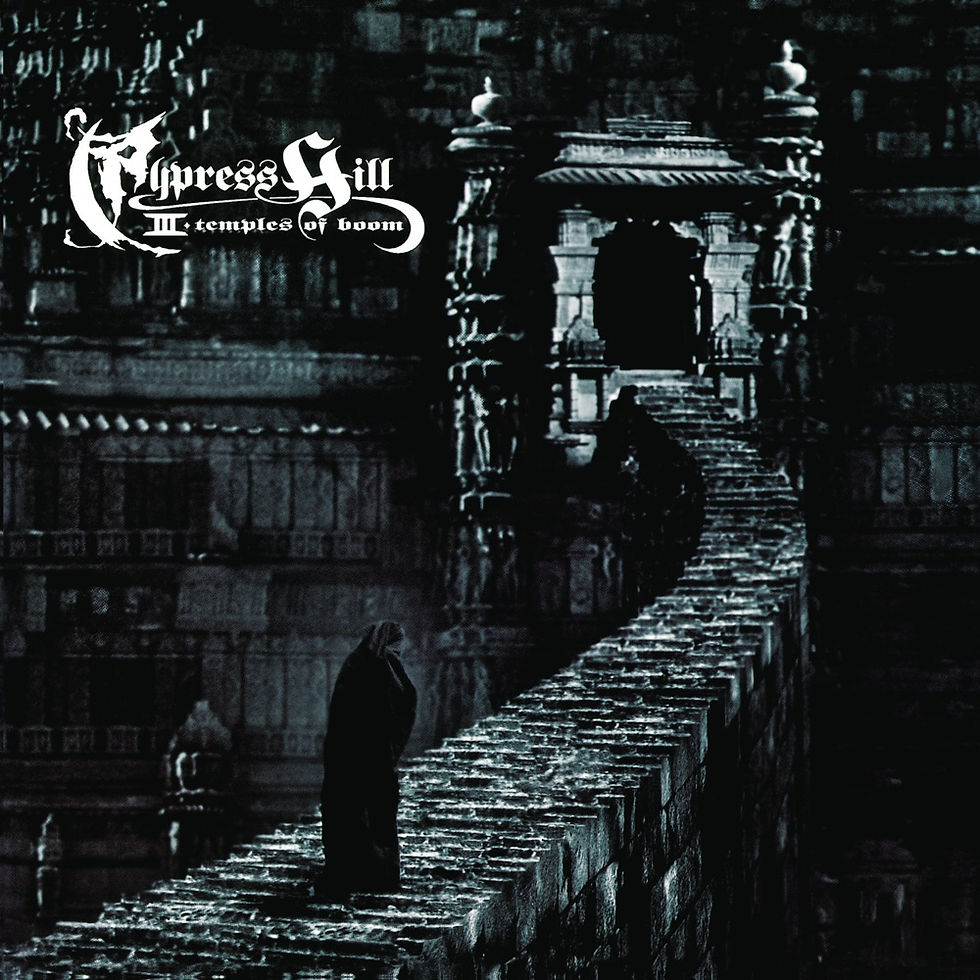
The album's visual vision, shot and designed by photographer and artist Dante Ariola with art director David Coleman, also perfectly complemented the music. The antique sepia-toned cover depicted a mysterious Buddhist temple shrouded in heavy fog, while the album booklet opened to a dark gallery of stone statues, skulls, and lit candles, an aesthetic that became one of the most recognizable symbols of mid-1990s rock and alternative metal culture.
Upon its release on Halloween Eve, October 31, 1995, "III: Temples of Boom" rocketed straight to number three on the US Billboard 200 and number three on the R&B & Hip-Hop Albums chart, quickly achieving platinum status in the United States with sales of millions of copies worldwide. Although some mainstream critics were initially surprised by its dark, slow, and contemplative tone compared to its predecessor, the passage of time has transformed the album into a revered masterpiece that has profoundly influenced an entire generation of trip-hop, alternative hip-hop, and nu-metal producers. Three decades after its release, "III: Temples of Boom" stands as a monument to artistic courage, the moment when "Cypress Hill" refused to recycle itself and chose to build a temple of dark, timeless sound that proves its power with every new listen.
For Listening: Spotify, Apple Music
"Face/Off" - Israel's Rock Blog


Comments