


Cypress Hill - Black Sunday

Updated: 3 days ago
On July 20, 1993, "Black Sunday", the second studio album by the band "Cypress Hill", was released.
In the summer of 1993 the American music world was in the midst of a multi-front cultural revolution. While the Seattle grunge scene and alternative metal dominated the radio stations and the main stages, and on the West Coast the slick G-Funk sound of Dr. Dre and Snoop Dogg defined the face of commercial hip-hop, a crew emerged from the neighborhoods of South Gate in Los Angeles that refused to obey the rules of any of those camps. The members of "Cypress Hill", made up of the rappers Louis Freese, known as B-Real, and Senen Reyes, known as Sen Dog, together with the producer and musical mastermind Lawrence Muggerud, aka DJ Muggs, joined by percussionist Eric Correa, known as Bobo, had already proven with their self-titled 1991 debut that they were a rising and original force. But no one in the music industry foresaw the commercial and artistic earthquake that their second album, "Black Sunday", was about to cause.
What made "Cypress Hill" such a unique phenomenon in those years was its natural, unapologetic and deep connection to the world of heavy rock and metal. During the intensive tours that accompanied the debut album, headed by the legendary "Lollapalooza" festival, the band members shared stages with acts such as "Rage Against the Machine", "Soundgarden", "Pearl Jam", "Ministry" and "Beastie Boys". There Muggs and his friends discovered that the rock and metal audience, which was looking for heavy, dark, rebellious and uncompromising music, connected to their slow rhythms, dirty basslines and gloomy atmosphere no less than the traditional hip-hop audience did. That same year they even took part in the masterful and influential soundtrack of the film "Judgment Night", on which they collaborated on two historic songs with the band "Sonic Youth" and with "Pearl Jam", a step that established them as crossover pioneers who paved the way for the rise of nu-metal and rap-metal later in the decade.
When the band members entered 38 Fresh Studios in Los Angeles and Image Recording Studios in Hollywood at the end of 1992 to record their second album under the Ruffhouse and Columbia Records labels, the atmosphere around them was far denser, more paranoid and darker. After seventeen exhausting months on the road, and under the enormous pressure to repeat the platinum success of the debut, DJ Muggs decided to abandon the light, sunny groove of California in favor of a gloomy, gothic and psychedelic wall of sound, based on samples from psychedelic rock records, dark Funk, old soul and smoky jazz from the sixties and seventies. B-Real completed this equation, having developed for the debut his nasal, high and sharp singing style, influenced by the cinematic figure of a brutal gangster and by the theatricality of horror films, against the thick, rough baritone of Sen Dog, creating a vocal dynamic that sounded like a live street duel.
The album opens with the uncompromising statement of intent of "I Wanna Get High", a hypnotic track in which a slow, heavy drum beat, accompanied by hazy sitar sounds and a sample from "Taxman" by "The Beatles" as performed by Junior Parker, draws the listener into the cloud of smoke identified with the band, which in those years became the official standard-bearer of the cannabis legalization movement in the United States. But right after the seemingly calm opening, the album changes direction sharply and plunges into the violent survival stories of the streets of Los Angeles with "I Ain't Goin' Out Like That". This song, which was co-produced with the producer Todd Ray, known as T-Ray, and was recorded while the band members were under the influence of hallucinogenic mushrooms in the studio, was built from an ingenious combination around the chilling blues harmonica loop of Ozzy Osbourne from the song "The Wizard" on the seminal 1970 debut album of the band "Black Sabbath". The union between Osbourne's dark harmonica and the crushing boom-bap beat and furious chorus turned the song into a power anthem that perfectly bridged heavy metal fans and hip-hop lovers.
Right after that comes the moment that turned "Cypress Hill" into a global, cross-continental phenomenon, the lead single "Insane in the Brain". Ironically, the song was born out of a bitter feud with the rapper Chubb Rock, who claimed the band had stolen a vocal style from him. In response, Muggs created a wild and unconventional beat that combined a drum sample by George Semper with the famous horse whinny from the song "Good Guys Only Win in the Movies" by the band "Mel and Tim", while B-Real fired off sharpened rhymes that turned the slang expression of the street gangs of Los Angeles, who called someone who had lost his sanity "Loco in the Coco", into one of the best-known choruses in the history of modern music. The song leapt to number one on the rap chart and to number 19 on the general Billboard chart, earned the band a Grammy nomination, and became a permanent anthem on dance floors and in rock clubs alike.
The dark, cinematic and tough side of the album continues at full force on the fourth track, "When the Shit Goes Down". Here Muggs sampled the dramatic piano and string opening from "Deep Gully" by the blues-rock band "The Outlaw Blues Band", alongside the rough voice of the legendary blues singer Howlin' Wolf, to create a tense urban Western atmosphere in which B-Real describes a police siege and gang violence with no way out. Later comes "Lick a Shot", an aggressive, dense piece in which B-Real honestly reveals the real moments of terror he experienced in his youth when he was shot in the lung during a street deal gone wrong and almost lost his life, over a heavy Funky beat that converses with "The J.B.'s" of James Brown.
The second half of the album proves how rich, adventurous and varied DJ Muggs's studio work was. After the humorous and biting interlude "Legalize It", comes "Cock the Hammer", built on the menacing bassline from "Blind Man" by the rock and Funk band "Black Merda" and combining Miles Davis samples with rhythmic verbal gunfire. Songs like "Lil' Putos" and "3 Lil' Putos" show off the band's cinematic storytelling talent through a cruel parable about three young men swept into a life of crime, while "What Go Around Come Around, Kid" and "A to the K" maintain a tight, rough drum sequence.
But the ultimate cult moment of the second half is reserved for the track "Hits from the Bong". In one of the great production strokes of the nineties, Muggs took the classic soul ballad "Son of a Preacher Man" by the British singer Dusty Springfield from 1968, slowed down and deepened its bass and guitar line, and mixed into it real bubbling water sounds recorded in the studio together with a quote from the film of the comedy duo Cheech & Chong. The surreal combination of Springfield's nostalgic warmth with B-Real's psychedelic lyrics created a timeless classic that closes the album together with the rhythmic "Hand on the Glock" and "Break 'Em Off Some", in which the psychedelic guitar of "The Jimi Hendrix Experience" is sampled from "Are You Experienced?", a perfect closing of the circle with the rock legends of the sixties.
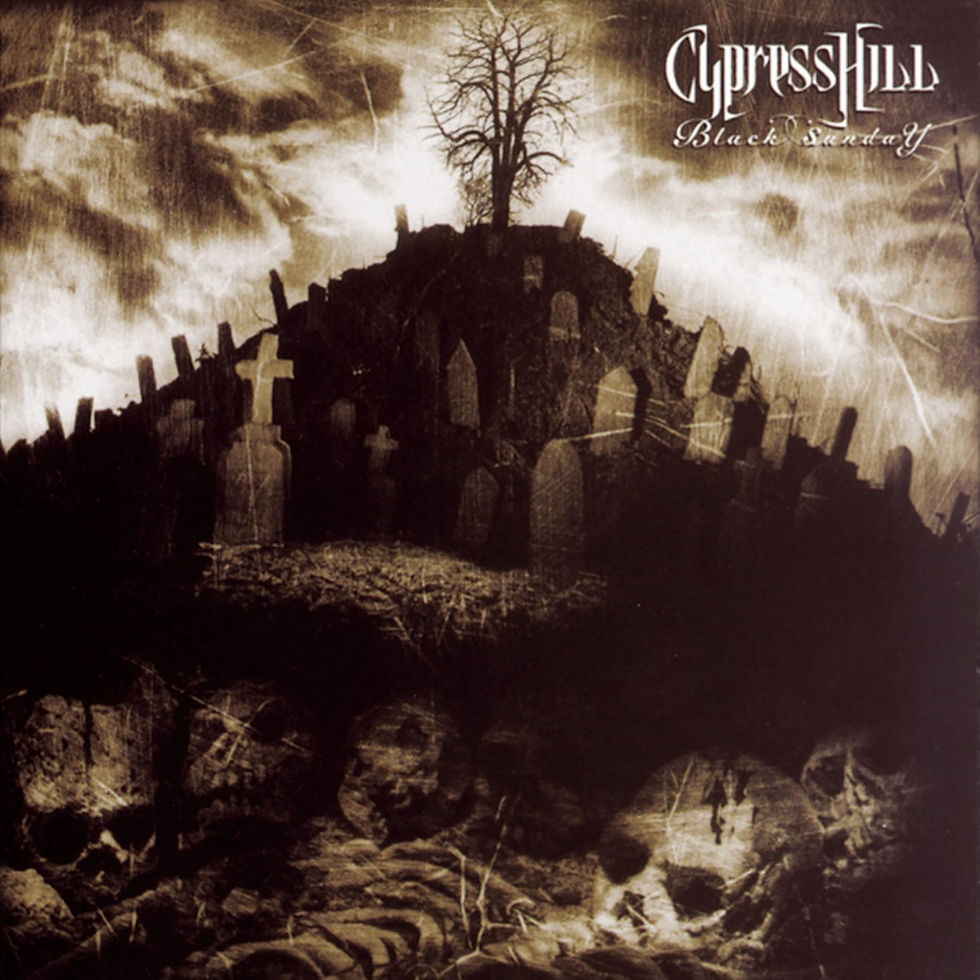
The iconic cover of "Black Sunday", designed by the graphic collective Paw Print, also played a central role in the mythology of the work. Unlike the customary hip-hop covers of the period, which showed photographs of the rappers with luxury cars or jewelry, "Cypress Hill" chose an aesthetic taken directly from the world of heavy metal, like "Iron Maiden" and "Grateful Dead". The black, gloomy cover showed an ancient, winged stone skull sprawled in a fog-shrouded cemetery, alongside an album booklet that contained detailed historical, economic and medical facts about the industrial and medical uses of the hemp and cannabis plant.
Upon its release on July 20, 1993, "Black Sunday" achieved an unprecedented historic feat when it entered straight at number one on the American Billboard 200 chart, with sales of over 261 thousand copies in the first week alone, making "Cypress Hill" the first Latino hip-hop group in history to take the top of the chart. Moreover, that very same week the band's debut album also returned to the albums chart, and so "Cypress Hill" became the first rap group ever to hold two albums simultaneously in the top ten of the Billboard chart. The album reached triple platinum status in the United States and sold more than four million copies worldwide. More than three decades after its release, "Black Sunday" remains not only the peak of the work of the crew from South Gate, but a musical monument that shattered the walls between hip-hop, psychedelic rock and metal, and proved that when the honesty of the street meets dark and fearless sound artistry, an eternal classic is born.
For Listening: Spotify, Apple Music
"Face/Off" - Israel's Rock Blog


Comments