


Van Halen - Diver Down

On April 14, 1982, "Van Halen" released their fifth studio album, "Diver Down".
Five cover versions, three instrumentals and barely half an hour of music. On paper, "Diver Down" looks like an album that owes its listeners an explanation. Put it on, though, and the opening riff makes a rather convincing case for dropping the interrogation. This is "Van Halen" at their most restless and mischievous, moving from hard rock to Motown, flamenco and old-time jazz with the confidence of a band that assumes it can get away with anything. Sometimes it does. Sometimes you wish it would stay with a good idea a little longer.
Coming after the dark, muscular "Fair Warning", the change in mood is striking. That album had given Eddie Van Halen room to pursue a tougher, stranger sound, but it had produced no US Top 40 singles. David Lee Roth had a different instinct for what made the band irresistible. He understood the power of a familiar tune, a ridiculous grin and a performance that made the audience feel invited to the party. "Diver Down" catches those instincts sharing the same studio, with producer Ted Templeman helping turn an unlikely collection of material into a commercially potent record.
The album was not supposed to happen quite so soon. After the "Fair Warning" tour, the band intended to take a break. David Lee Roth suggested releasing a cover single to keep their name in circulation, initially proposing "Dancing in the Street". Eddie Van Halen preferred Roy Orbison's "(Oh) Pretty Woman", whose riff gave him something more immediate to work with. Recorded at Sunset Sound in Los Angeles, the single became a hit, and "Warner Bros." wanted an album to follow it. The sessions that followed were famously compressed into twelve days. That rush helps explain the record's shape, though it tells us surprisingly little about how much pleasure there is inside it.
The useful distinction is between a shortage of new songs and a shortage of imagination. "Diver Down" has only four original vocal songs among its twelve tracks, but several of its best ideas arrive between the choruses. Eddie Van Halen treats these short pieces as opportunities to change the room around us. The album's quick turns can interrupt its momentum, yet they also reveal a musician whose curiosity reaches well beyond the expectations attached to a guitar hero.
Listen to "Cathedral". By combining hammer-ons, rapid movements of the guitar's volume knob, echo and chorus, Eddie Van Halen softens the attack of the notes until the instrument seems to breathe like a church organ. There is something unexpectedly tender about it, a moment of stillness from a player so often associated with speed. "Intruder" works in the opposite direction, scraping and groaning its way through an unsettling landscape of feedback and metallic noise. It was recorded because the "(Oh) Pretty Woman" video needed more music to fill its running time. Whatever its practical origin, the collision between that sinister introduction and the familiar riff is wonderfully absurd.
The cover of "(Oh) Pretty Woman" is relatively straightforward, and that is part of its appeal. Eddie Van Halen makes the riff heavier without burying its spring, while David Lee Roth exchanges Roy Orbison's yearning for a swaggering come-on. There is no need for a showpiece solo. The band gets its effect through tone, timing and sheer personality. The opening "Where Have All the Good Times Gone!", borrowed from "The Kinks", is rougher and more impatient. Its backward glance at better days becomes a bar-room complaint delivered by musicians who sound thoroughly delighted to be making a racket.
"Dancing in the Street" is the more revealing cover. Beneath the familiar vocal melody, Eddie Van Halen builds a pulsing Minimoog figure, doubled with guitar, that gives the Motown standard a glossy, mechanical shimmer. The lyric still invites everyone outside, but the street now seems to run through an early-eighties arcade. For us, the arrangement is ingenious without being entirely satisfying. It has colour and a strong groove, yet some of the communal exuberance of the original gets lost in the machinery. The use of a musical idea Eddie Van Halen had wanted for an original composition also became a point of friction. Here, the question of whose song it was mattered almost as much as how it sounded.
For all the attention given to the covers, the originals are the best reason to return. "Hang 'Em High" hurtles forward on a twisting riff, with Alex Van Halen and Michael Anthony keeping the whole thing moving beneath David Lee Roth's outlaw imagery. Its music grew from the earlier "Last Night", with rewritten lyrics for this version.
Then there is "Secrets", one of the loveliest things this lineup ever recorded. Eddie Van Halen's twelve-string guitar gives the chords a luminous breadth, while Michael Anthony's harmonies lift the melody without crowding it. David Lee Roth describes a woman whose freedom is inseparable from her refusal to stay, and for once his voice seems more enchanted than triumphant. The solo answers that mood with restraint and warmth. Eddie Van Halen had wanted the piece on "Fair Warning", where it was passed over. Here it becomes essential, giving the album a depth of feeling that its party reputation tends to conceal.
"Little Guitars (Intro)" and "Little Guitars" deserve to be heard together, but they are distinct pieces. The brief acoustic prelude grew from Eddie Van Halen's fascination with Carlos Montoya's flamenco playing. Rather than reproduce the technique faithfully, he found his own way to suggest its flowing tremolo and bass movement. The main song switches to a miniature electric guitar built by David Petschulat, and the change is exhilarating. A bright, nimble figure opens into one of the band's most inviting melodies, with yearning in the vocal and a buoyant rhythm underneath. The playing is dazzling, but the tune is what stays with us. This is the album's strongest argument for giving its original material more room.
The strangest detour is also its most affectionate. "Big Bad Bill (Is Sweet William Now)", a comic standard about a feared tough guy domesticated by marriage, brings Jan Van Halen, the father of Eddie Van Halen and Alex Van Halen, into the studio on clarinet. His sons step into an acoustic jazz setting and David Lee Roth plays the amused storyteller. It can sound like an interruption if you came for wall-to-wall riffs. We hear a family moment worth keeping, and a reminder that the band's musical education began long before the amplifiers were turned up.
"The Full Bug" restores the dirt under the fingernails. David Lee Roth supplies the acoustic opening and harmonica as well as the vocal, before the band tears into a blues-soaked charge. It is brash, fast and gloriously physical, with Alex Van Halen pushing the rhythm hard enough to make the more polished covers seem a world away. After that, the a cappella "Happy Trails" waves everyone out the door. The closing joke works because the harmonies have been part of the band's charm all along. Still, its brevity adds to the feeling that the album ends just when another substantial original could have brought it into focus.
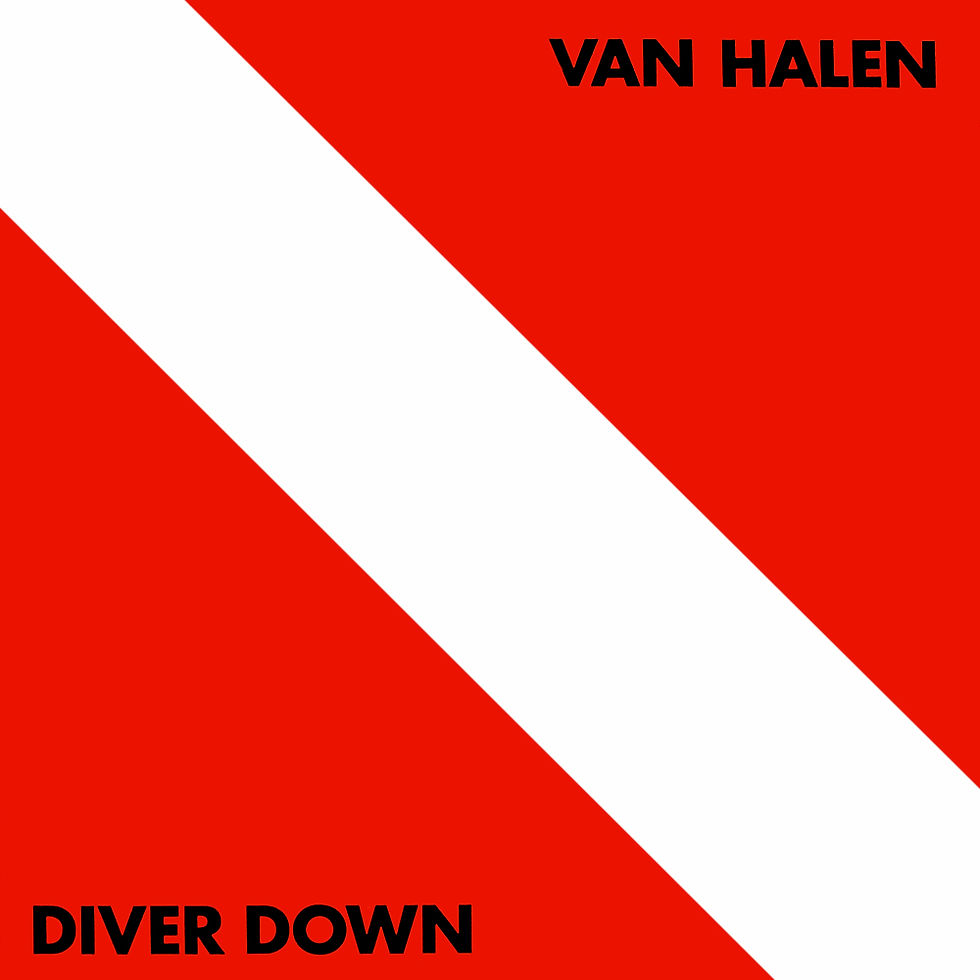
Even the sleeve offers a small clue to the contradictions inside. Its red field and diagonal white stripe reproduce a diver-down flag, signalling activity beneath the surface. It is a beautifully simple design for a record whose cheerful exterior conceals disagreements about repertoire and creative control. Those differences would become more consequential as Eddie Van Halen sought greater independence in the studio, ahead of the sixth album, "1984".
Commercially, the gamble paid off. "Diver Down" reached No. 3 on the Billboard 200, the band's highest album placing at that point. "(Oh) Pretty Woman" reached No. 12 on the Hot 100, and "Dancing in the Street" reached No. 38. The public had little difficulty embracing an album that mixed recognisable songs with such an unmistakable band sound.
For Listening: Spotify, Apple Music
"Face/Off" - Israel's Rock Blog


Comments