


Tom Waits - Rain Dogs

Writer: Moti Kupfer
Release date - 30.09.1985
The image that defined Tom Waits’ early career was taken by Mitchell Rose for "Rolling Stone" at the Tropicana Motel in West Hollywood in 1977.
Waits had rented a room there for several years, yet the photograph makes it look as if he had moved in only an hour earlier. Beer bottles are scattered across the coffee table. His guitar case sits on top of a large cardboard box.
He leans forward with his hands clasped, looking skeptical, perhaps a little annoyed, but hardly embarrassed by the shabby state of his home. He sits in a folding lawn chair that has not seen sunlight in a very long time.
The following year, Waits released his sixth LP, "Blue Valentine", on "Asylum". Founded by David Geffen and Elliot Roberts in 1971, the label became a showcase for Southern California talent that shaped the post-Woodstock singer-songwriter scene: artists such as Judee Sill, Jackson Browne and Joni Mitchell.
Waits knew some of them from shared bills and from the scene around the Troubadour in Los Angeles, where manager Herb Cohen had discovered him. But he never quite fit in.
For singer-songwriters of that era, the prevailing approach was personal expression. You were expected to draw your songs directly from your life, write about friends and lovers, and change just enough detail to keep them from being recognized.
Waits had no interest in that kind of confession. Instead, he turned the idea upside down and began shaping his life around his songs. For Tom Waits, music offered a way to become somebody else.
With a record deal in hand, and inspired by the Beat Generation and countercultural figures such as Charles Bukowski, he wrote about people at the margins and the ragged lives of the street.
As his voice grew smokier and more scorched, Waits realized that he could not remain a wandering, melancholy barroom singer telling stories of the downtrodden forever. He felt trapped in the character he had created.
That began to change when he met Kathleen Brennan, a script supervisor he had encountered a few times. They fell deeply in love and were engaged within a week. From then on, his creative life seemed to divide into a period before Kathleen and a period after her. One of the latter period’s unquestionable high points was "Rain Dogs", released on September 30, 1985.
Perhaps Brennan’s greatest contribution was the confidence she gave him. If Waits feared letting go of the persona that had defined his recording career, she persuaded him that something better lay within his reach.
She also widened his musical horizons, introducing him to avant-garde artists such as Captain Beefheart, Harry Partch and Gavin Bryars, whose work would matter greatly in the next phase of his career.
When his contract with "Asylum" ended, Waits moved to "Island Records". By the time of 1983’s "Swordfishtrombones", he was already rummaging through a musical junk shop for wheezing accordions, delicate glass harmonicas, African drums, marimbas and all manner of percussion. Those sounds continued to evolve on "Rain Dogs".
His earlier work drew on theater and film, but these new songs also took shape among the creative community of downtown New York’s experimental music scene.
Waits felt an affinity with some of its players. He became friends with saxophonist and composer John Lurie of "The Lounge Lizards", and through Lurie he met jazz guitarist Marc Ribot.
He brought in drummer Stephen Hodges and bassist Larry Taylor, both veterans of "Swordfishtrombones". Hodges was astonished by how quickly and thoroughly a group of musicians formed around Waits. He told biographer Barney Hoskyns that Waits seemed like New York’s "frigging Pope": he took care of business and seemed to be everywhere at once.
Waits finally overcame his hesitation and asked Keith Richards to play on the record. The living legend agreed. After years of telling guitarists that he wanted the feel of "The Rolling Stones", Waits now had the confidence to ask one of the Stones himself.
The album is, in a way, a tribute to New York’s street people, its rejected and broken souls, each with a small, strange story to tell. Many of the musicians were people Waits knew from the city’s avant-garde scene.
Waits wrote much of the album while hiding away in a Manhattan basement. Now and then he went walking through the city, recording the sounds he heard, and those sounds helped give the record its grimy atmosphere. It became the middle chapter of a trilogy that began with "Swordfishtrombones" and ended with 1987’s "Franks Wild Years".
In one sense, "Rain Dogs" is a concept album about New York’s down-and-out residents. Yet the connections among its 19 tracks make it even more compelling as a focused musical portrait of an artist reinventing himself after moving from one coast to the other.
Waits used a broad range of instruments to find its sound, including marimba, accordion, double bass, trombone and banjo. What stands out is the organic quality of the record and the physical means by which its sounds were made.
Speaking about his distrust of fashionable studio techniques, Waits said that when he wanted a sound, he felt better if he had hunted it down, skinned it and cooked it himself. An engineer might suggest sampling the tap of a stick against a cup and enlarging it in the mix. Waits would rather go into the bathroom and strike the door with a piece of drum hardware.
On "Clap Hands", Waits uses a simple trick. He takes the vocal rhythm and chant of the children’s tune "The Clapping Song" and passes them through his surreal imagination, always circling back to the title.
If you ever find yourself in a nightmare where nothing makes sense and see children skipping rope on a street corner, "Clap Hands" is the song they will be singing.
Waits displays his wild sense of humor on "Cemetery Polka", singing about aging relatives who are mad, dying, or both.
"Time is a precious commodity," Waits said while introducing "Time" on a promotional cassette for "Rain Dogs". That thought gets to the heart of the song. Each verse turns toward another person on the street and the hardships they face.
The title track draws on the idea of dogs that leave home and lose their way in the rain because the water has washed away the scent trail that could lead them back.
In interviews from 1985, Waits described "rain dogs" as a metaphor for lost people in pain, people without a sense of direction. They sleep in doorways and have no social or physical place to call home.
A brief respite from the album’s surrounding gloom arrives with "Downtown Train". Some critics dismissed it as a conventional bid for a hit, and its later history gave them an obvious argument: Rod Stewart recorded it near the end of the decade and took his version to number three on the Billboard Hot 100 and into the UK Top 10.
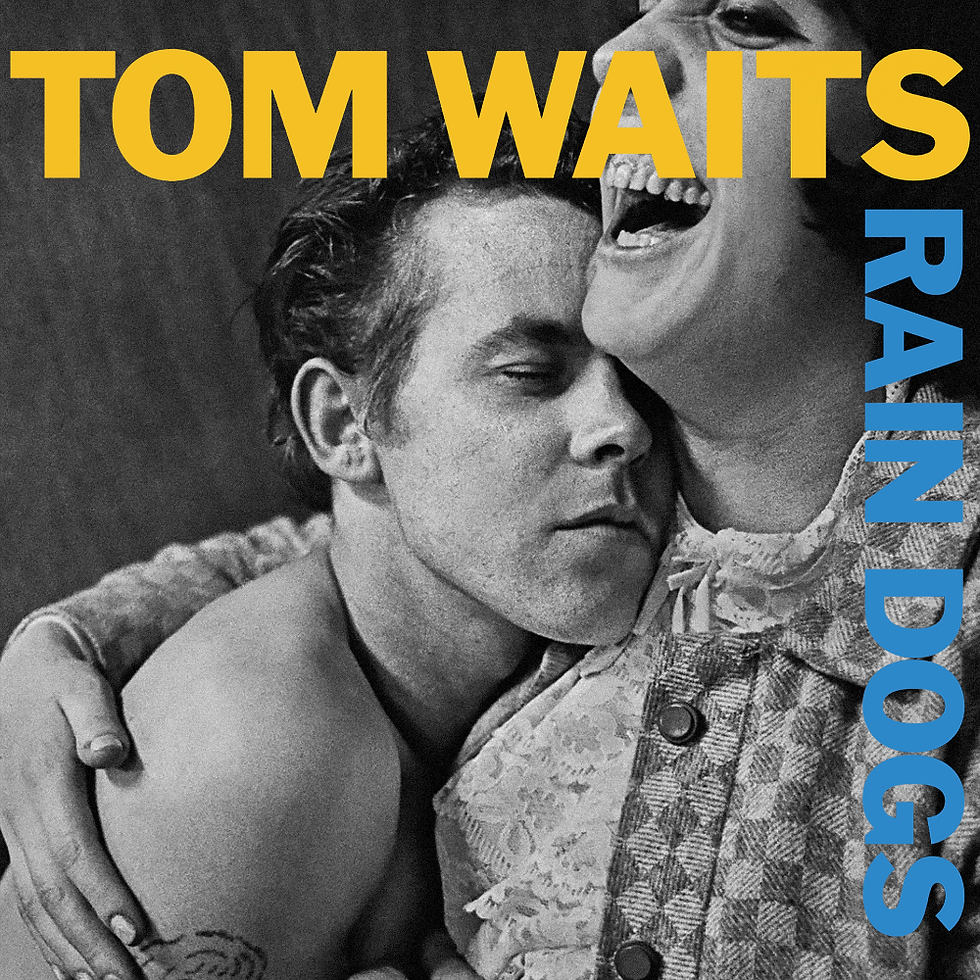
The cover image comes from photographs that Swedish photographer Anders Petersen took in the 1960s at Café Lehmitz on the fringes of Hamburg.
Although the man on the cover looks remarkably like Waits, the photograph actually shows a man and a woman named Rose and Lily.
Thom Yorke of "Radiohead" remembered one of his great albums: "I fell asleep while listening to it on my Walkman, only to wake the next morning with it still inside my head. Every track was a short film set in a mysterious, circus-like, desolate America I barely understood. Different characters emerged through both the words and the instruments. For a few minutes, an entire universe opened up to me, only to drop me at the far end of the block with no idea how I had got there."
"Every word seemed to rhyme so effortlessly that I could only dream of writing something like it myself. The words fell from his tongue so beautifully, yet they never gave everything away; half the story remained his own. Waits inhabited a character whose darkness and humor felt much more real than anything that was trying to seem real. I have never tired of this album, even after playing it over and over throughout my life, and my children grew up hearing it too."
For Listening: Spotify, Apple Music
"Face/Off" - Israel's Rock Blog


Comments