


Suede - Dog Man Star

Written by: Moti Kupfer
Release date - 10.10.1994
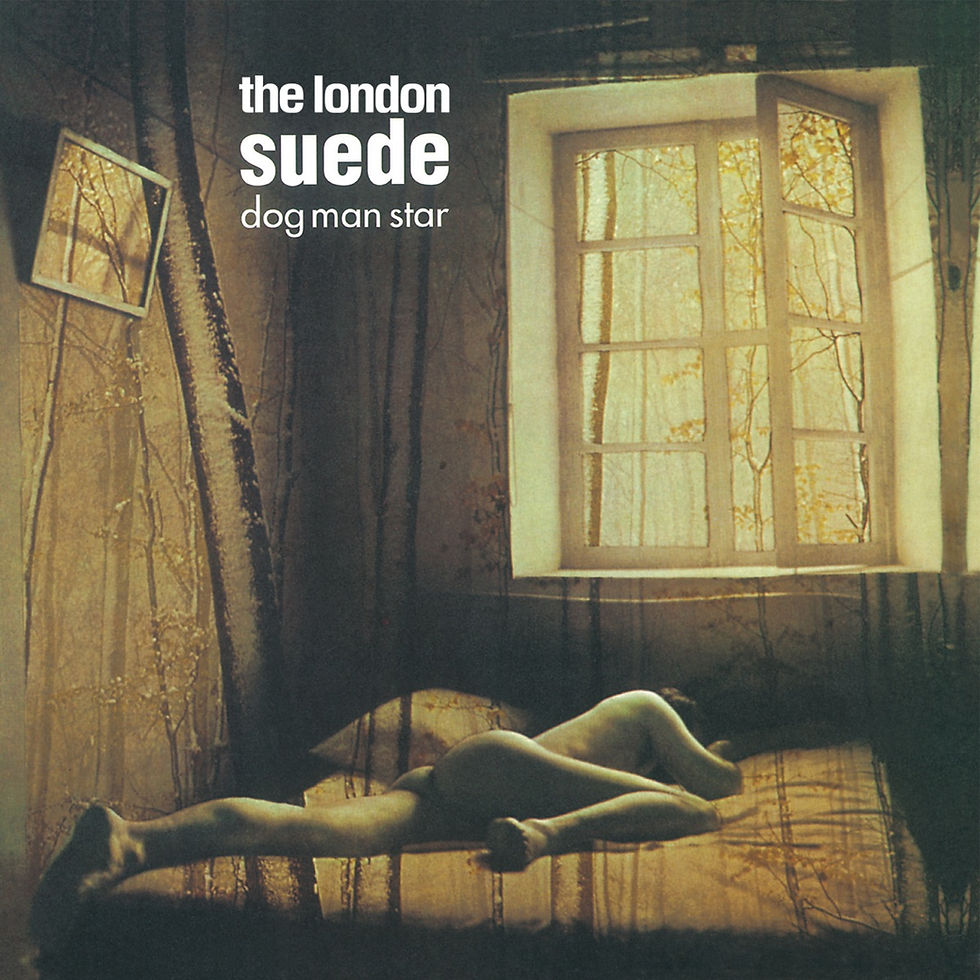
By the end of 1993, following a landmark debut album, the music magazines had crowned "Suede" the leading band in Britain. This happened just before bands such as "Blur", "Oasis" and "Pulp" surged to the forefront.
As happens to many bands that achieve meteoric success with an exceptional debut, the breakthrough brought difficulties that the members struggled to handle. In 1993, they set out to win over American audiences, with "The Cranberries" as their support act.
"Suede" arrived in the United States feeling like superstars. The British press had spoiled them a little too much. During their second tour, in the autumn of 1993, they watched in surprise as "The Cranberries" found success with "Linger", moving from support act to headliner at several shows, with "Suede" going on before them.
As if that were not enough, just before the second tour began, bad news arrived from Britain: Bernard Butler's father had died. The band had to cancel the first week of the American tour and fly back to London from New York.
When the tour resumed, Butler, grieving for his father and now engaged to his girlfriend Elisa, distanced himself from his bandmates more than ever. According to Butler, they resented being on tour with someone who did not want to party. He even travelled separately, sometimes alone in a taxi and sometimes on "The Cranberries"' tour bus.
By early 1994, as "Suede" prepared to release the standalone single "Stay Together", morale within the group had reached an all-time low.
According to drummer Simon Gilbert, Butler had become intolerable and impossible to work with, and the band could no longer function together.
To record their next album and escape the noise and gossip, Brett Anderson moved to a secluded flat in Highgate, north London.
Anderson's new home, a garden flat on Shepherd's Hill, was chosen partly out of superstition, since 16 is the singer's lucky number, and partly to escape the rise of Britpop, a movement his band had helped pioneer.
Its chronicle of distorted English life had become something "Suede" wanted no part of. Their own world was lonely and fractured by internal conflict. From this far from ideal starting point, Anderson began writing the lyrics for their next album, "Dog Man Star", released on October 10, 1994.
Anderson, who had deliberately cut himself off from the media, watched countless films and attributed the album's extravagant sound to his use of psychedelic drugs. He said he was taking a great deal of acid at the time, which gave them the confidence to push boundaries. Anderson flourished in the surreal environment he inhabited during that period.
Nearby lived a community of Mennonites, an Anabaptist Christian denomination with roots closely related to those of the Amish. Its members would often sing hymns during Anderson's drug binges. Shut away in Highgate, Anderson tried to match his songwriting partner's wild ambition through a diet of psychotropic drugs, old films and a wide range of reading, from Romantic visionaries such as William Blake to prophets of dystopian doom such as George Orwell and J. G. Ballard.
If their previous album roamed the territory of glam rock, somewhere between David Bowie and "The Smiths", "Dog Man Star" was darker and more experimental, partly because of Butler's taste for extended solos. A prime example is the nine-minute epic "The Asphalt World". According to bassist Mat Osman, the piece originally ran for no less than 25 minutes, including an eight-minute guitar solo by Butler.
It was one of the songs Anderson wrote under the influence of his relationship with his 17-year-old girlfriend Anick. He said that monogamy did not interest him at that stage, and that sexual jealousy could also inspire him.
At the time, Butler was writing other complex arrangements, exploring progressive rock and appearing in a BBC programme about "Pink Floyd". Osman later expressed the feeling that Butler's compositions were too experimental, and that the musical ideas demanded more of listeners than many were prepared to give.
The arguments between Butler and his bandmates that began over "The Asphalt World" spread to the rest of the album as Butler grew increasingly unhappy with Ed Buller's production. Butler wanted Buller removed so that he could produce the album himself.
Butler gave the band and their management an ultimatum: either they fired Buller, or he would leave. His bandmates refused to meet his demands and decided to part ways with him before recording was finished. Butler maintained that he had been forced out, having arrived at the studio one day to discover he was not allowed in. In his account, he returned the following day to collect his guitar and was told over the intercom that it would be brought outside to him in the street. Buller disputed this version, saying the guitars had been left at the studio's reception desk.
One of the album's defining qualities was its dramatic lyricism. This is hardly surprising, since Anderson adopted a stream-of-consciousness approach to writing while taking psychedelic drugs and watching a large number of film noirs during the process.
The lyrics here are considerably more melodramatic than on the previous album. Take the second single, "The Wild Ones", also inspired by his girlfriend Anick. This ballad took its name from Marlon Brando's 1953 biker film, "The Wild One".
Anderson described their relationship as passionate and broken, the kind you have when you are young. At the time, he was listening to singers such as Scott Walker, Édith Piaf, Frank Sinatra and Jacques Brel, musicians whose emotional and musical range could turn a song into a drama. That was the direction he wanted to pursue here.
Anderson said that much of the album's sexuality was inspired by Prince. Butler, meanwhile, drew inspiration from "The Queen Is Dead" by "The Smiths", "Closer" by "Joy Division", "Torment and Toreros" by "Marc and the Mambas", and "The Righteous Brothers".
Elements of Anderson's lyrics were shaped by his drug use, and he cited Blake as a major influence on his writing. He was fascinated by visions and trance-like states as a means of creation, and said much of the fragmented imagery in the opening track, "Introducing the Band", came from allowing his subconscious to take over. The song was a mantra he wrote after visiting a Buddhist temple in Japan.
Lewis Carroll, the author of "Alice's Adventures in Wonderland", whom Anderson was reading at the time, also influenced the lyrics. An Orwellian tone seeped into the second track and lead single, "We Are the Pigs", which depicts Anderson's visions of civil rebellion and riots in the streets.
Anderson described the realisation that the grotesque house of cards they had built around themselves was collapsing, and that the only way to deal with it was to embrace and celebrate its destruction, dancing around the bonfire. His vision was of a post-apocalyptic landscape in which society had disintegrated and humanity was reduced to its primal animal form. The song's title was inspired by Anderson's old school band, "The Pigs".
Other songs on the album explored personal themes such as loneliness against a backdrop of wealth and fame. "The 2 of Us" portrays a successful couple unable to connect emotionally.
"This Hollywood Life" addresses that universal rule of the music business whereby an artist must sacrifice something of themselves, and sometimes humiliate themselves, to achieve success and recognition.
Even James Dean's life and death enter the picture, as the singer imagines a relationship with the dead movie star in "Daddy's Speeding".
At odds with the world, with reality, with Britpop and with one another, "Suede" were in a terrible place while writing and recording "Dog Man Star", an album that threatened to tear them apart. Who could have known then that it would become their most significant work?
Anderson spoke of the album's title as a kind of shorthand Darwinism, reflecting his journey from the gutter to the stars. Fans, meanwhile, noted its resemblance to experimental filmmaker Stan Brakhage's 1964 film, "Dog Star Man".
The album cover uses a photograph taken by American photographer Joanne Leonard in 1971, showing a naked man sprawled on a bed. The image was taken from a 1972 book titled "Frontiers of Photography".
For Listening: Spotify, Apple Music


Comments