


Red Hot Chili Peppers - Mother's Milk

Red Hot Chili Peppers - Mother's MilkOn August 16, 1989, "Red Hot Chili Peppers" released their fourth studio album "Mother's Milk".

There are albums that represent artistic evolution, and there are albums that exist because a band somehow survived long enough to make them. "Mother's Milk" belongs to both categories. Following 1987's "The Uplift Mofo Party Plan", "Red Hot Chili Peppers" suffered the event that could easily have ended the band. Guitarist Hillel Slovak died of a heroin overdose in June 1988, a loss that devastated every member in different but deeply personal ways. For Anthony Kiedis, Slovak’s death was a brutal confrontation with the consequences of the lifestyle he himself was still struggling with, forcing him into a period of guilt, reflection, and attempted sobriety. For Flea, Slovak had been not only a bandmate but a close creative counterpart from their earliest days, and his death left a void in both his musical identity and his sense of stability within the group. Drummer Jack Irons was so shaken by the loss of his closest friend that he withdrew entirely, unable to reconcile continuing in a band so closely tied to Slovak’s memory, and he subsequently left. The tragedy also marked a turning point in how the remaining members viewed the band itself: no longer just a chaotic creative outlet, but something fragile that had already cost them someone irreplaceable. In the aftermath, Kiedis and Flea were left with a decision that went beyond replacing musicians. They had to determine whether continuing "Red Hot Chili Peppers" was an act of denial, tribute, or necessity, and whether the music they had built with Slovak could meaningfully exist without him.
Their first attempts at rebuilding did not last... DeWayne "Blackbyrd" McKnight briefly occupied the guitar position, while D.H. Peligro passed through the drum seat. The crucial change came with the arrival of 18 year old John Frusciante, a devoted fan who had studied Slovak's playing but possessed enough musical knowledge to take that vocabulary somewhere else. Frusciante later explained that he had not really been a funk guitarist before joining the group and learned how to interact with Flea partly by studying Slovak. Then came Chad Smith, whose huge, physical drumming immediately gave the rhythm section a different kind of force. The lineup of Kiedis, Flea, Frusciante and Smith was born, and with it came the configuration that would eventually define the band's most celebrated periods.
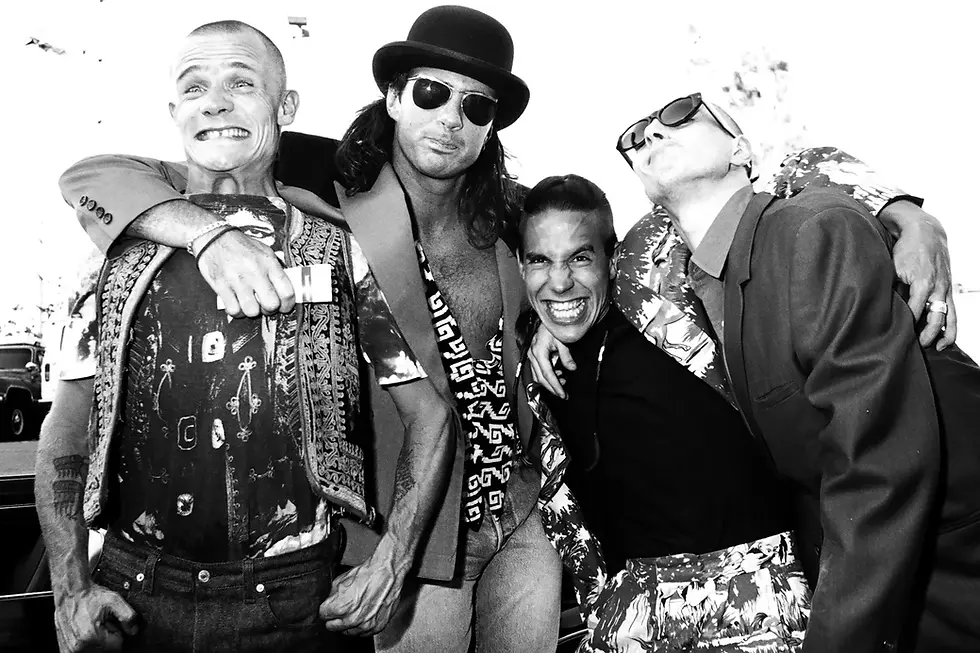
The new musicians did not merely replace Slovak and Irons. They changed the mechanics of the band. During early sessions the group played constantly, developing material through jams and learning how the new lineup reacted to one another. "Knock Me Down", for example, emerged from that process rather than from producer direction. Frusciante brought greater harmonic knowledge and a rapidly developing melodic instinct, while Smith gave Flea a drummer capable of meeting his aggressive bass playing with enormous weight. Producer Michael Beinhorn, who had already worked with the band on "The Uplift Mofo Party Plan", recognized Frusciante's unusual technical and theoretical ability almost immediately.
The album was recorded between late 1988 or early 1989 and April 1989, primarily at Ocean Way Studios and Image Studios in Los Angeles, with Beinhorn producing and Dave Jerden handling the mix. Yet the relationship between producer and guitarist became one of the defining tensions of the record. Beinhorn pushed Frusciante toward a thicker, heavier guitar sound, including extensive layering. Frusciante later remembered being made to quadruple guitar parts, an experience that affected how he approached recording for years afterward. That tension is essential to understanding "Mother's Milk". This is Frusciante before he discovered the economy that would later become one of his greatest strengths. Even he has acknowledged that on this record he was trying to fill too much space.
And "Mother's Milk" certainly fills space. It practically attacks it.
"Good Time Boys" opens the album like four musicians trying to prove that the reconstructed band is not going to collapse. Flea's bass refuses to function merely as a foundation, bouncing around the arrangement as an almost equal lead instrument, while Smith hits with considerably more physical force than the band's earlier records had possessed. Frusciante's guitar is dense and abrasive, and Kiedis delivers his words rhythmically rather than melodically. The song can feel overcrowded, but that excess is part of the record's character. "Mother's Milk" does not yet understand restraint because the musicians themselves are still discovering where they fit.
Then comes the inspired decision to reinterpret Stevie Wonder's "Higher Ground". Rather than politely reproducing the original's funk, "Red Hot Chili Peppers" turn it into something almost violently physical. Flea translates the famous keyboard figure into a muscular slap bass assault, Smith drives the song with enormous kick and snare impact, and Frusciante coats the arrangement in distorted guitar. Kiedis rides the groove with more confidence than technical sophistication, but that is precisely why it works. The performance captures the bridge the band was constructing between 1970s funk, hardcore energy and the heavier alternative rock that would explode in the following decade.
"Subway to Venus" shows how ridiculous and sophisticated the band could be simultaneously. The rhythm section changes direction with almost cartoonish enthusiasm, while the brass arrangement expands the funk foundation into something much more colorful. Frusciante constantly decorates the groove instead of simply sitting on it. The result is chaotic, but the chaos is increasingly organized. You can hear a band beginning to realize that virtuosity does not have to remove the sense of danger.
That danger reaches another extreme on "Nobody Weird Like Me". Flea's bass line is the engine, frantic enough to sound as though the song might outrun itself, while Smith keeps everything brutally grounded. Kiedis responds with one of the album's most manic vocal performances. Structurally it is closer to controlled impact than conventional songwriting, and that is exactly the point. It represents the old Chili Peppers instinct at maximum velocity, but now powered by a rhythm section capable of making the insanity sound enormous.
The emotional center is "Knock Me Down", where the circumstances surrounding "Mother's Milk" finally become impossible to separate from the music. Written in the shadow of Slovak's death, the song confronts arrogance, mortality and self destruction without completely abandoning the band's physical energy. Most importantly, Frusciante's vocal is pushed alongside Kiedis rather than buried behind him, creating an unusual dual voice. The guitars still have Beinhorn's heavy production, but underneath the distortion is a melodic instinct pointing directly toward the band's future. This is one of the moments where "Mother's Milk" stops sounding like a successful reconstruction and begins sounding like the first draft of a new band.
"Taste the Pain" takes another step away from pure funk punk aggression. Recorded before Smith joined the group, with Fishbone drummer Philip "Fish" Fisher playing drums, it has a noticeably different rhythmic feel. The verses create more breathing room, Kiedis sounds unusually vulnerable, and the arrangement demonstrates that melody was becoming increasingly important to the band's identity. The track is less concerned with overpowering the listener than much of the surrounding album, making its emotional unease considerably more effective.
Elsewhere, "Mother's Milk" remains gloriously inconsistent. "Stone Cold Bush" is driven by a vicious bass and guitar exchange and demonstrates just how quickly Frusciante and Flea had developed their musical conversation. "Punk Rock Classic" compresses the band's punk instincts into less than two minutes of deliberate absurdity. Their version of Jimi Hendrix's "Fire", recorded earlier with Slovak and Irons, functions almost like the ghost of the previous incarnation appearing inside the new album. It reminds the listener that this transformation was not planned. One version of "Red Hot Chili Peppers" had ended abruptly, and another was being assembled around the wreckage.
But perhaps the most revealing piece is the tiny instrumental "Pretty Little Ditty". Surrounded by an album obsessed with volume, slap bass, distortion and impact, its restraint is startling. Frusciante and Flea allow melody and space to carry the composition, and suddenly another possible future for the band appears. There is no need for Kiedis to dominate the track and no need for the musicians to prove how hard they can play. The melodic sensitivity that would become increasingly important on later records is already hiding inside this brief instrumental. Apple Music similarly identifies it as the album's sparse, tender outlier.
The closing "Johnny Kick A Hole In The Sky" brings the album back toward confrontation, with Flea and Smith driving a restless rhythmic foundation beneath Kiedis' forceful delivery. By this point the record's greatest strength and weakness have become the same thing. Everything is exaggerated. The bass is enormous, the drums are enormous, the guitars are stacked and aggressive, and Kiedis is constantly fighting to stay above them. There is little of the spaciousness that would make the band's next phase so powerful.
That is precisely why "Mother's Milk" remains such an important "Red Hot Chili Peppers" album. It is not the fully realized masterpiece that followed. It is the sound of the machinery being rebuilt.
Frusciante would eventually learn that playing less could make Flea and Smith sound bigger. The band would eventually discover that vulnerability could be as powerful as aggression. Their production would eventually leave more air between the instruments. But those lessons had to come from somewhere, and many of them were learned here. Frusciante himself later looked back on the record as a period when his guitar playing occupied too much space, a realization that helped shape the more economical musician he became.
"Mother's Milk" therefore stands at one of the most important intersections in the band's history. Behind it lies Slovak, Irons and the reckless underground funk punk band of the 1980s. Ahead lies the chemistry of Kiedis, Flea, Frusciante and Smith, the lineup that would eventually transform "Red Hot Chili Peppers" into one of the biggest rock bands in the world.
For Listening: Spotify, Apple Music.


Comments