


King Crimson - Discipline

On September 22, 1981, "King Crimson" released its eighth studio album, "Discipline".

This was not just another prog album, nor was it an attempt to revive the sound of the 1970s. "Discipline" marked the moment when "King Crimson" redefined itself and, in the process, showed progressive rock how to enter the 1980s without pretending punk, new wave and post-punk had never happened. In place of long solos, symphonic keyboards and nostalgia came music that was taut, geometric and physical, with four musicians thinking together in real time. The album reveals itself first through its precision, but lingers in the memory because of the curiosity, humor and danger concealed within that precision.
Seven years had passed since "Red" and the breakup of the previous lineup. In the meantime, Robert Fripp worked with Brian Eno, David Bowie and Peter Gabriel, listened to minimalism and absorbed the hard-edged energy of the new scene. When he began assembling a band called "Discipline", he was not looking to recreate "King Crimson", but to build an entirely different musical mechanism. Only after the quartet had begun performing did he realize that this new identity was not an escape from the old name, but the only way that name could become real again.
The turning point was the meeting between Robert Fripp and Adrian Belew, a guitarist and singer who had already worked with Frank Zappa, David Bowie and "Talking Heads". They were joined by Tony Levin, who brought the Chapman Stick and the ability to move between bass, percussion and harmony, and Bill Bruford, who returned with acoustic and electronic drums and a willingness to abandon the predictable beat. This was not a band with one leader and three sidemen. Each musician had an irreplaceable color, and the friction between the four became a method of composition.
The name "Discipline" remained as the album title and its key word. Printed on the back cover was the idea that discipline is never an end in itself, but a means to an end. The statement describes the music perfectly: every part is meticulously constructed, yet the result is no mathematical exercise. Discipline creates freedom, because each musician knows exactly where he stands even as the meter changes, the accents shift and the two guitars draw different patterns through one another.
The album was recorded in May and June 1981 at Island Studios in London, with the band and Rhett Davies sharing production duties. The material came together relatively quickly, took shape onstage and entered the studio after the quartet had already learned to breathe as a single body. That collective character is essential here: rather than clearing a space for a soloist, the other instruments keep working. At times, each musician seems to be playing a different piece, yet their point of intersection creates a new order.
Within that order came together sources that, at the time, rarely shared the same room: Indonesian gamelan, Steve Reich-style minimalism, funk, punk, new wave and post-punk. Robert Fripp's synth guitar sometimes assumed roles once reserved for keyboards; Adrian Belew's guitar spoke, laughed and roared; Levin's Stick turned the bass line into an independent lattice; and Bruford built polyrhythms and asymmetrical rhythms without losing the sense of motion. Progressive rock remained progressive because it stopped sounding like the memory of itself.
The opening track, "Elephant Talk", makes the album's intentions clear at once. Levin's Stick riff is both bass line and rhythmic engine, Bruford slices through the space with precise strokes, and the two guitars move between nervous lines and animal-like sounds. Adrian Belew arranges words about speech and communication in alphabetical order, then demonstrates through voice and guitar just how easily language can become noise. It is funny, catchy and strange, but also the perfect introduction to an album in which intellect and pleasure are not enemies.
The next track, "Frame By Frame", sharpens the album's central invention. Two clean, angular guitar lines mesh and separate like gears; at one point, one of them drops a note from its cycle, gradually pulling the music out of phase. The influence of cyclical minimalism is unmistakable, yet the rock body remains alive and kicking. Levin and Bruford do not merely keep time; they set another kind of time against the guitars, allowing the listener to hear several rhythmic layers at once.
After that density comes "Matte Kudasai", whose Japanese title means "please wait". It is a delicate, atmospheric ballad, but even here the band avoids the expected. Adrian Belew's voice floats above a warm bass line and a guitar that sounds like a solitary seabird. Robert Fripp adds translucent layers instead of melodrama, and the space between the notes becomes as important as the notes themselves. The track proves that the band's new restraint could also produce fragile beauty.
On the album's second side sits "Indiscipline", the title track's unruly twin. The text grew out of a letter written by Margaret, Adrian Belew's wife, describing a painting she had made. He broke her words into short, suspicious and obsessive phrases, delivering them somewhere between speech and a shout. Around him, the band erupts and stops, shifting from ominous washes to jagged blows. Bruford is given enormous space, yet even when the drums sound completely free, they remain tied to a taut internal structure. With each repetition, the phrase "I like it" becomes less reassuring and more unhinged.
Behind "Thela Hun Ginjeet" lies a story that became inseparable from the recording. The title is an anagram of "Heat in the Jungle". When Adrian Belew went out into the streets of London to record ambient sound, he encountered a group that threatened him and was later questioned by the police. When he returned to the studio, shaken, and told the others what had happened, Robert Fripp recorded him without his knowledge. The story entered the song, turning real fear into rhythmic theater. The tension between patterns of four and seven creates a sense of pursuit, while the guitars and Stick build a crowded city that never stops moving.
The space opens up again on "The Sheltering Sky", an instrumental that grew out of an improvisation and took its name from Paul Bowles's novel. Bruford establishes a ritual pulse, Levin maintains a low, insistent motion, and above them the synth guitars paint heat, dust and horizon. There is no dramatic development here in the conventional Western sense. Change comes through accumulation, timbre and repetition, much like a gamelan ensemble in which the shared pattern matters more than the soloist. This is one of the moments when the album stops sounding like a rock band and begins to sound like an ecosystem.
"Discipline" closes the album, distilling the band's method to almost complete transparency. The two guitars play different but complementary cycles, the parts pass between them, and the Stick and drums shift the center of gravity without breaking the flow. The asymmetrical rhythm is not a technical ornament but the subject itself. After the chaos of "Indiscipline", this track presents the other side of the same coin: not control that suppresses energy, but a structure that allows four minds to act as one.
The album cover tells the same story. The red and blue Celtic knot looks ancient and modern, organic and geometric at once, a single line that grows tangled but never breaks. The original image was based on the work of Celtic art scholar George Bain, and later editions replaced it with a new design by Steve Ball after copyright questions arose. Either way, the knot became a precise symbol of the music: independent parts winding around one another until they can no longer be separated.
Upon its release, "Discipline" reached No. 41 on the UK chart and remained there for four weeks. in the United States, it reached No. 45. Those were respectable results for music this uncompromising, but the album's true importance grew over time. It showed a new generation of musicians that complexity did not have to mean excess, that music could be danceable without being simple, and technological without losing its personality. Its echo can be heard in math rock, experimental alternative rock and any band that uses repetition and shifting meters to create tension rather than display expertise.
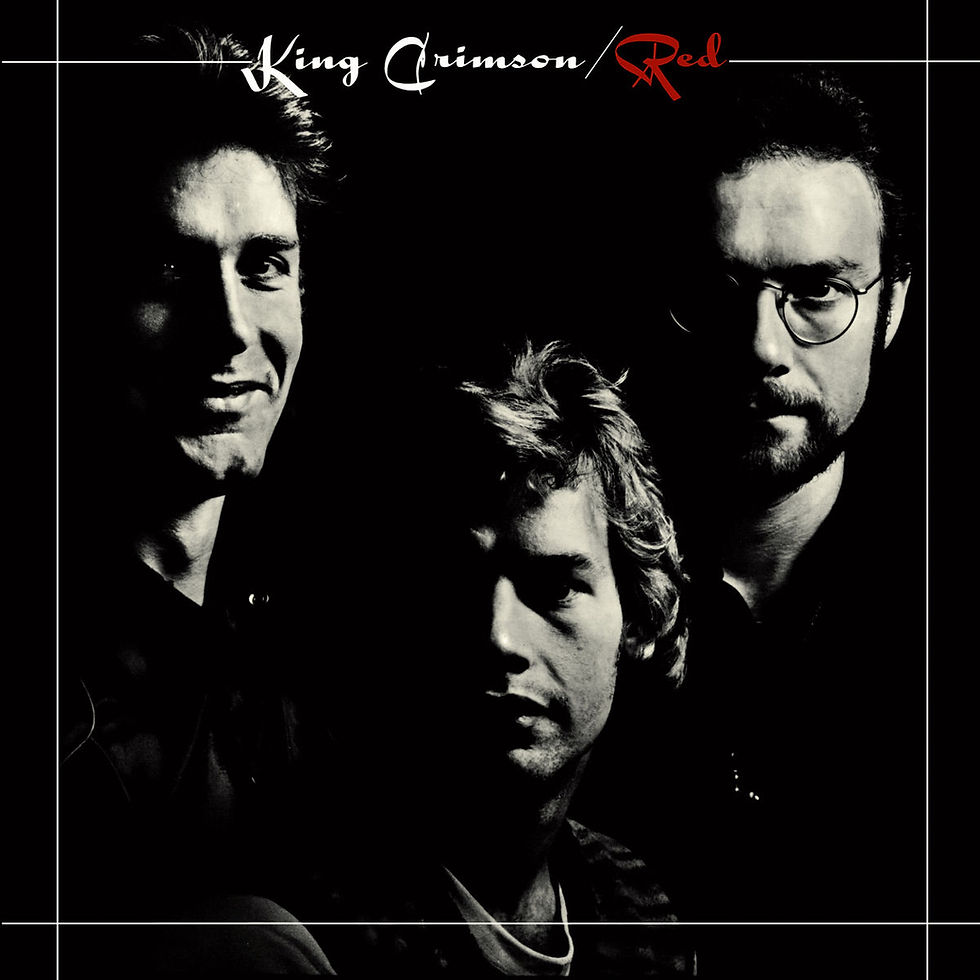
In retrospect, it was also the first entry in the band's 1980s trilogy, preceding "Beat" and "Three of a Perfect Pair". It does not erase the past represented by "In The Court Of The Crimson King" or "Red"; instead, it proves that the deepest principle behind "King Crimson" was never a particular style. It was the willingness to change the moment a familiar language became too comfortable.
More than four decades later, "Discipline" still sounds contemporary because it does not belong to any single fashion. Indonesian gamelan, new wave, post-punk, minimalism, synth guitars, the Chapman Stick and polyrhythm are not a pasted-together list of influences. They became one personal, inimitable language. The meeting of Robert Fripp, Adrian Belew, Tony Levin and Bill Bruford did more than produce a new lineup. It redefined what progressive rock could be in the 1980s.
That is why the album is regarded as a landmark and remains so highly valued among serious listeners. It demands attention, but it is never cold; it is sophisticated, yet full of physicality and humor; it is precise, but at every moment it feels as though something might veer off course. "Discipline" offers no formula that can simply be copied. It offers a position: listen to a changing world, learn from it, and then build from it music no one has heard before.
For Listening: Spotify, Apple Music
"Face/Off" - Israel's Rock Blog


Comments