


Kansas - Point of Know Return

On October 11, 1977, "Kansas" released their fifth studio album, "Point of Know Return", a record that packed progressive rock, blazing guitars, and a soaring violin into a surprisingly accessible commercial triumph.
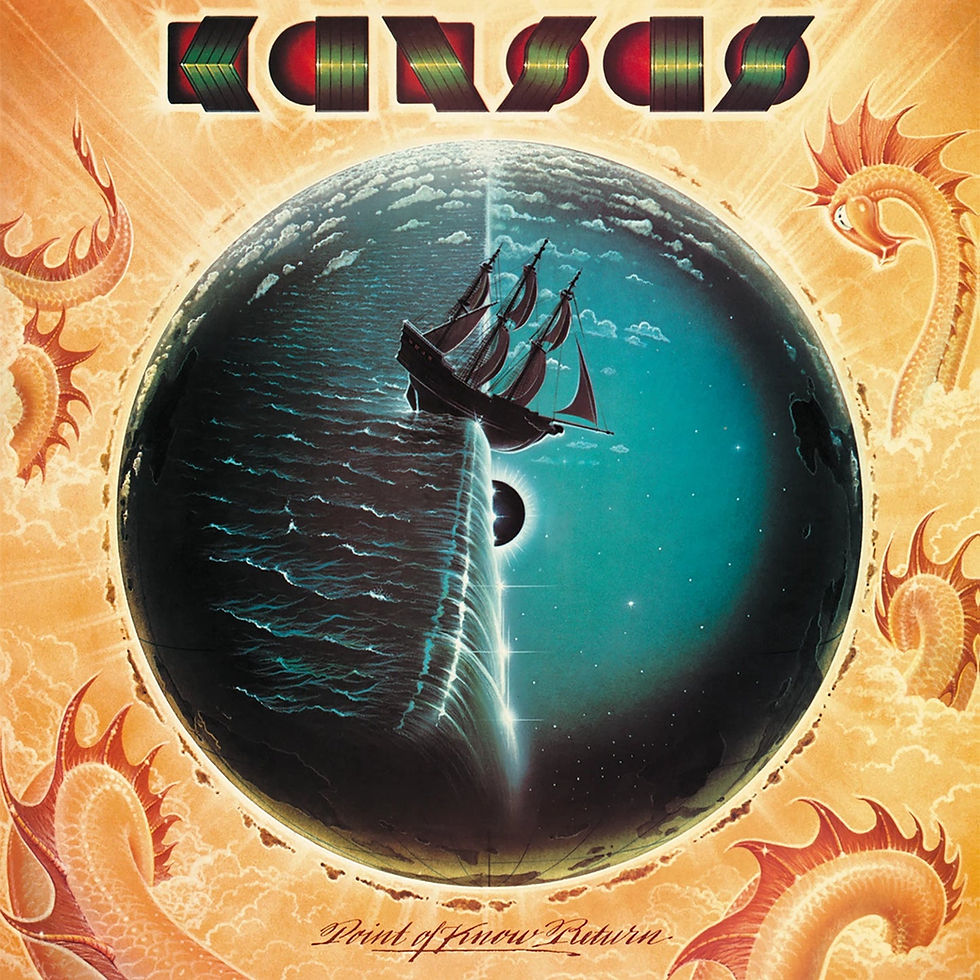
An ancient sailing ship approaches the edge of the world, where the maps end and the unknown begins. On the cover of "Kansas"' fifth album, the danger seems almost tangible, but the musical voyage within is every bit as thrilling. Six musicians at the height of their success push the boundaries of American rock, twist rhythmic patterns, pit a violin against electric guitars, and somehow find a hint of eternity in a simple acoustic melody. It is an album that invites us to sail far beyond the horizon while reminding us just how brief the journey can be.
Only a year earlier, "Kansas" had broken through with "Leftoverture", an album that brought the sophistication of British progressive rock together with the raw drive of American hard rock. "Carry On Wayward Son" propelled the band into a new league, but it also unleashed a whirlwind of touring, pressure, and expectations. Suddenly, musicians who had once fought for every listener were faced with a new challenge: how to build on that success without becoming a pale imitation of themselves.
At the heart of the band were two very different creative forces. Guitarist Kerry Livgren was drawn to ambitious compositions and spiritual and philosophical questions, while Steve Walsh, the singer and keyboardist, brought an explosive stage presence and a remarkable ability to make every melody feel deeply human. Tensions became serious enough for Walsh to step away from the band during preparations for the album, though he eventually returned. Alongside them were guitarist Rich Williams, bassist Dave Hope, drummer Phil Ehart, and violinist and vocalist Robby Steinhardt. Without Steinhardt's unmistakable violin, it is almost impossible to imagine the sound of "Kansas".
Work began in June 1977 at Studio in the Country in Bogalusa, Louisiana, but equipment problems led the band to move most of the recording to Woodland Sound Studios in Nashville. Jeff Glixman returned as producer. Despite the disruptions, the result sounds remarkably focused and alive, with every instrument contributing something essential rather than merely decorating the arrangements.
The opening title track, "Point of Know Return", is a dazzling statement of intent. In just over three minutes, the band packs in shifting time signatures, darting violin phrases, muscular guitars, and a chorus made to be sung at full volume. Replacing the word "No" with "Know" turns the familiar point of no return into a journey toward the limits of human understanding. Perhaps that is the real magic of "Kansas": music this intricate has no business sounding so effortlessly radio-friendly.
On "Paradox", the guitars and keyboards weave around one another as the rhythm section charges ahead. "The Spider", a brief instrumental written by Walsh, gives the drums and keyboards room to run wild. Yet none of this feels like virtuosity for its own sake. Even in the trickiest passages, the band's sheer excitement at discovering another musical path is impossible to miss.
We move on to "Portrait (He Knew)", inspired by Albert Einstein and the distance between extraordinary knowledge and a complete understanding of existence. Razor-sharp riffs collide with an expansive chorus, as though science and imagination were competing for the same patch of sky. "Closet Chronicles" takes a darker, more theatrical turn, with arrangements that suggest a story larger than life. This is "Kansas" at their progressive best: sophisticated, melodic, and unexpectedly inviting.
Then comes "Dust in the Wind", a reminder that a few strings and one unsettling thought can sometimes reach deeper than an entire wall of amplifiers. Kerry Livgren had been practicing a fingerpicking exercise on his acoustic guitar at home when his wife, Vickie, heard the melody and encouraged him to write lyrics. He doubted that such a quiet piece belonged on a "Kansas" album. When the band needed more material, he reluctantly played it for the others, only to find that they loved it and insisted on recording it. There are no roaring electric guitars here, just a delicate acoustic texture and an immortal violin line that reaches exactly where it needs to.
The lyrics were inspired by Native American poetry, prompting Livgren to reflect on the fleeting nature of human life. The arrangement also holds a lovely technical detail: alongside a conventionally tuned acoustic guitar, another was recorded in Nashville tuning, with its lower strings raised an octave to give the picking its shimmering quality. "Dust in the Wind" reached No. 6 on the Billboard Hot 100, but its power has little to do with chart positions. It is a timeless anthem rediscovered by each generation, because all of us know the feeling of time slipping away far too quickly.
On the second side of the vinyl, "Lightning's Hand" and "Sparks of the Tempest" bring the electricity roaring back. The band accelerates, bares its teeth, and reminds us that beneath the philosophical questions and intellectual ambition are six rock musicians who know how to raise the roof. The bass and drums hold the whole structure together while the violin and guitars seem to climb the walls.
As the album approaches its end, the light begins to fade. "Nobody's Home" imagines a world without human beings, a chilling idea made even more haunting by the beauty of the music. "Hopelessly Human" closes the album by bringing grand musical ambition face to face with human frailty. After a voyage beyond the horizon, perhaps the answer is not waiting at the edge of the world after all. Perhaps it lies in accepting our limitations.
The famous cover completes the voyage. Peter Lloyd painted a ship seemingly approaching the edge of a flat Earth, an image conceived by the band in the spirit of the title track. According to the members of "Kansas", it was actually their manager, Budd Carr, who suggested the title's play on words.
The album "Point of Know Return" reached No. 4 on the Billboard album chart and was certified quadruple platinum in the United States.
For Listening: Spotify, Apple Music


Comments