


ELO - Out of the Blue (1977)

On October 24, 1977, "Out of the Blue", the seventh studio album and a double LP by "Electric Light Orchestra (ELO)", was released in the United States. It arrived in Britain four days later.
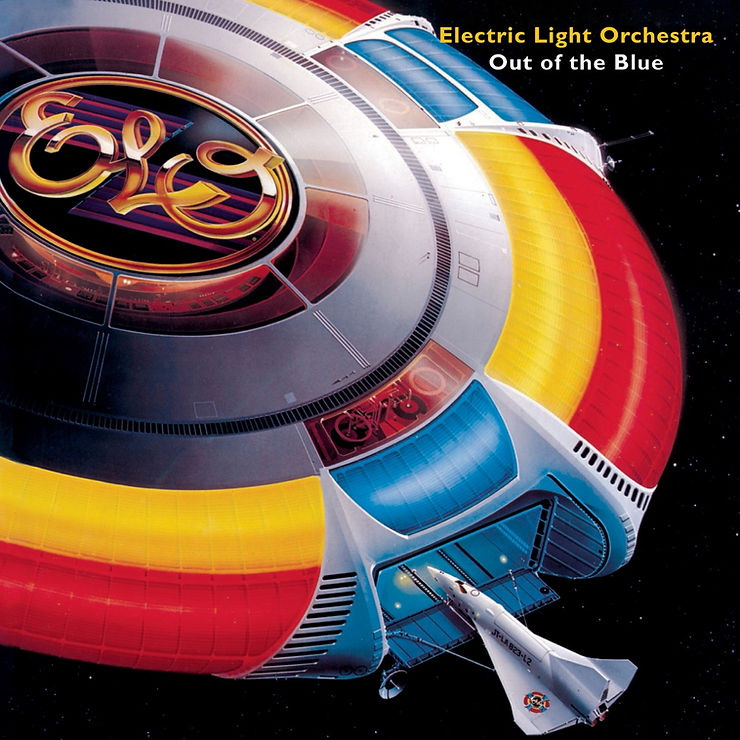
In the year when punk set out to shorten songs and dismantle pretensions, Jeff Lynne hired more musicians, opened up more studio tracks and released a double album. Oblivious? More like the confidence of a songwriter who knew exactly what he was doing. "Out of the Blue" is one of those rare cases where a huge appetite is justified almost all the way through. Seventeen tracks, roughly 70 minutes, and choruses big enough to fill stadiums.
"ELO" arrived here after the success of 1976's "A New World Record", the album that brought their blend of rock, pop and orchestration into particularly sharp focus. Emerging earlier in the decade from "The Move" and Roy Wood and Jeff Lynne's idea of bringing strings into rock and roll, the band had already moved far beyond the rough experiments of their early days. After Wood's departure, Lynne became their central creative force. He no longer needed to prove that a cello and an electric guitar could coexist. He wanted to find out how far that partnership could go.
In the spring of 1977, Jeff Lynne retreated to a rented chalet near Bassins in Switzerland to write the next album. The rain fell, the mountains disappeared into the clouds, and inspiration was in no hurry to arrive. Then the weather cleared. Lynne recalled the sun lighting up the mountains as the mist lifted, a change that gave him the inspiration for "Mr. Blue Sky". Within a few weeks, the material for the album had been written. The story may sound almost too good to be true, but it neatly captures the album's mood. Even when the music drifts into melancholy, it keeps looking for an opening to let the light in.
Jeff Lynne turned those chalet ideas into recordings at "Musicland" studios in Munich between May and August 1977. He wrote the words and music and produced the album, working alongside recording engineer Reinhold Mack. Lynne, Richard Tandy and Louis Clark handled the orchestral and choral arrangements, with Clark also conducting the orchestra. The original credits thank Mack for 1,127 hours at the console. Anyone wondering where all those hours went should listen to this album on headphones.
Alongside Lynne, the lineup featured Richard Tandy on keyboards, Kelly Groucutt on bass and vocals, Bev Bevan on drums, Mik Kaminski on violin, and Hugh McDowell and Melvyn Gale on cello. Everyone had a role in this densely packed sound. The bass and drums kept its feet on the ground, the keyboards opened up new spaces, and the strings could lead the melody, answer the singer or drive the rhythm. Layers of vocals and effects joined them, including the vocoder, which gives the human voice an electronic character. In "ELO"'s 1977 world, even the robots had harmonies.
It is always worth remembering how emotional this music is, because the production's polish can be deceptive. Beneath those gleaming choruses lie lyrics about the fear of loneliness, homesickness, separation and the desire to escape everyday life. Jeff Lynne is not a singer who hurls his pain at the listener. He wraps it in a melody so beautiful that it takes another listen to notice how much sadness has slipped inside.
Right from the opening, "Turn to Stone" captures that contradiction. The lyrics describe a man who freezes when his lover is away, but the buoyant music never stops running. The strings whirl, falsetto voices answer the lead vocal, and the rhythm pushes relentlessly forward.
"Sweet Talkin' Woman", originally written under the title "Dead End Street", refines that irresistible appeal. The search for the elusive woman moves through answering voices, sharp strings and rhythmic piano until the whole song becomes a wonderfully graceful chase. You can already hear the attraction to disco that would take a more central role on "Discovery", though here it remains part of a rich mixture of rock and pop. "It's Over", placed between these two hits, adds a sense of parting without sacrificing melodic grandeur. Interestingly, its title came from the end of the writing period in Switzerland, beyond the romantic story we might hear in it. Its orchestral opening uses a passage from "Mr. Blue Sky" played backward, another small connection between songs that initially seem entirely independent.
Beyond the hits, the album keeps finding ways to intrigue us. "Across the Border" sends us on a journey accompanied by violin and brass with a Mexican flavor. Next, at the beginning of side two, "Night in the City" trades that landscape for nervous motion, its keyboards and strings darting between the speakers like the streets that inspired the song. By contrast, "Starlight" settles into a soft, nocturnal soul atmosphere.
"Jungle" feels like something of an oddity. The animal noises, percussion and playful chorus offer a moment of deliberate silliness on an album whose construction was a very serious undertaking. Some listeners will enjoy the wink. Others may feel the joke runs a little too long.
By contrast, the transition from the brief "Believe Me Now" into "Steppin' Out" reveals the album's more serious side. The first prepares the ground with orchestra and a processed voice, while the second gives longing time to develop. The singing is almost hesitant at first, and the music gradually expands around it. This is a song about setting out, but also about the cost of leaving. It reminds us that the man behind this enormous production remains, amid all that beautiful noise, someone searching for his place.
Still, the heart of "Out of the Blue" lies on the record's third side. Under the subtitle "Concerto for a Rainy Day", four songs become a single progression. There is no attempt to present a classical concerto in the strict sense. Instead, this is pop songwriting that uses the continuity of an entire LP side to build tension, linger and reach a release that an isolated song cannot deliver with the same force.
The suite opens with "Standin' in the Rain". Rain and thunder draw us in, and the piano, keyboards and strings gradually turn the weather into musical drama. From there it moves into "Big Wheels", one of the band's loveliest and less frequently discussed ballads. There is no need to rush here. The melody unfolds slowly, the voices accumulate, and a sense of heaviness settles into the gentle sound. Then comes "Summer and Lightning", bringing movement and warmth to the sequence. Even before the sky clears completely, you can feel the air has changed.
Then comes "Mr. Blue Sky". The bouncing piano sounds like a window opening in a room that has been shut for a long time. The drums, vocal exchanges and rhythmic breaks make its joy energetic and full of surprises. The influence of "The Beatles" is clear in the love of melody, harmonies and little transitions, but the result belongs entirely to "ELO". Jeff Lynne lets us hear how much thought went into it without taking away the fun.
What makes the song so great is precisely what happens after the chorus fades. Bev Bevan produced that familiar metallic sound partly by striking a fire extinguisher, an amusing little detail within the lavish production. The orchestral ending restores the joy to the scale of the whole suite, and the electronic voice asks us to get out of our armchairs and turn the record over. Many listeners heard the song's title in those words, but it actually says "Please turn me over".
Side four may be the album's least consistent, but it still has its magic. "Sweet Is the Night", on which Kelly Groucutt shares the lead vocals with Lynne, brings back the human warmth. The instrumental "The Whale" heads toward electronic sounds and mysterious spaces, reminding us how much the studio itself served as an instrument for the band. Then "Birmingham Blues" brings the guitars and rock and roll back to their hometown. The transitions are sharp, and at times the sequence feels more like a collection of ideas than a unified whole, but almost every turn holds a detail worth hearing.
"Wild West Hero" closes the album, and the choice feels exactly right. The dream of becoming a hero in the Wild West is given honky tonk piano, played by cellist Melvyn Gale, expansive harmonies and the feeling of a Western glimpsed through an English child's window. Beneath the fantasy lies a simple wish for a different life. After space travel, storms and chases through the city, the album ends with a longing for a place that may never have existed. It is a beautiful conclusion to an album that believes so deeply in the power of imagination.
The sleeve gives that imagination a physical form, too. The spaceship illustrated by Shusei Nagaoka as part of Kosh's design expanded the circular logo seen on "A New World Record" into an entire world of colorful science fiction. Original editions also included a cardboard model to assemble. By 1978, the spaceship had reached the stage as a gigantic set piece on the tour.
The response was mixed. "Rolling Stone" took issue with the production and familiar influences, arguing that the sheen came at the expense of emotion. The public, however, responded enthusiastically. The album reached number four in both Britain and the United States, and three of its singles, "Mr. Blue Sky", "Wild West Hero" and "Sweet Talkin' Woman", reached number six on the British chart.
It is easy to see why "Out of the Blue" is considered one of "ELO"'s high points. Yes, some moments are less essential, and the sheer density occasionally leaves the listener needing a little air. But the melodies, harmonies and imaginative production give this double album a justification that many records of similar length struggle to find. Jeff Lynne managed to expand his music without losing himself. The great wonder is that, even after we know how it all works, when the piano of "Mr. Blue Sky" begins, we still want to get up and open the window.
Listen: Spotify, Apple Music
"Face/Off" - Israel's rock blog


Comments