


Ehud Banai - Karov

On September 15, 1989, Ehud Banai released "Karov", his second album.
After the breakthrough of "Ehud Banai VeHaPlitim", another album of rough-edged guitars and years of pent-up anger might have seemed the obvious next step. But Ehud Banai had other places to take us: the alleyways of Jerusalem's Old City, his grandparents' home, European roads and nights in the Galilee. On "Karov", he brought them together. The result is an album that can take us on a long journey and leave us feeling, at the end, that we have come home.
The 1987 debut followed years of false starts, odd jobs and wandering. Working with Yossi Elephant and "HaPlitim" gave Ehud Banai's songwriting the momentum it had been waiting for, establishing his already world-weary voice as one of the most distinctive in Israeli rock. Now that the door had finally opened, he began taking his music beyond the sound that had first introduced him to us.
Production duties went to Ovad Efrat of "HaKlik", who also shared the arrangements with Ehud Banai. Elephant did not play on the album, but Gil Smetana on bass, Jean-Jacques Goldberg on drums and Noam Halevi on percussion maintained the connection with "HaPlitim". They were joined by Shefi Yishai on piano and keyboards, Yaakov Friber on zarb, a Persian drum, and Yehudit Tamir on vocals and backing vocals. Ehud Banai played guitars, harmonica and sitar, among other instruments. Recording and mixing took place at "D.B. Studios" in March 1989, with Meni Bejarano engineering and Yaakov Moreno handling the mix.
Efrat's production gave the acoustic guitars, percussion and curling melodic phrases more room. Even when the music gathers intensity, the small details and the space between the instruments remain audible. The same year also brought "Tachat Siach HaYasmin" ("Under the Jasmine Bush"), on which Ehud Banai accompanied Persian folk tales told by his father, Yaakov Banai. The two albums illuminate one another: the son's musical curiosity is firmly connected to his family's storytelling tradition.
"Ruchot HaTzafon" ("Northern Winds") opens the album on the move. A young man leaves home and his sweetheart, convinced that real life is waiting somewhere else, only to discover that freedom can also mean loneliness. Ehud Banai tells the story almost in a single breath, with guitar and harmonica accompanying the shift from the excitement of departure to regret over what was left behind. The encounter with Diego, the trains and the love that draws near before slipping away give it the feel of a short story. As it unfolds, its adventurous hero becomes less certain of himself and more human. We are no longer simply curious about where he will end up. We hope he will have somewhere to return to.
"Kulam Yod'im" ("Everybody Knows") carries that tension into an irresistible rhythm and an easy-to-love melody. The narrator threatens to leave, yet promises within the very same verse to return and stay. There is something funny, familiar and painful about the distance between grand gestures of farewell and the simple need to be with someone we love. Even the knowledge that everything must eventually end cannot extinguish the joy here. Instead, it makes another day together matter. This is part of Ehud Banai's magic: a song we can sing at the top of our lungs, only to suddenly realize how sad it is.
The duet "HaChizayon LeFrancesco Goya" ("The Vision of Francesco Goya") opens onto an entirely different world. Ehud Banai set Pinchas Sadeh's words to music, while Yehudit Tamir brings a presence that is inseparable from the performance. Her voice rises above his rougher tone, deepening its dreamlike mystery. This is a moment to let go of the need to decipher every image straight away and listen to the longing carried by the voices and melody. An album full of tangible stories also makes room for things that resist explanation.
"HaKnafeh Metuka" ("The Knafeh Is Sweet") takes us back to Jerusalem, to a city of young wanderers, travelers, cafés and chance encounters. In a piece on his website, Ehud Banai recalled the allure of the Old City in the late 1960s and early 1970s, when a short journey could feel like a trip abroad. He also described how that freedom and innocence gradually gave way to suspicion and fear. Knowing this adds a pang to the song: the sweetness of its title belongs to a time that seemed more open, too. The unhurried music suits that wandering, that wish to linger a little longer before returning to everyday life.
Then comes "HaAgas 1" ("1 Pear Street"). More than seven minutes are devoted to a single address in Jerusalem's Mahane Yehuda market, to the family home above the shops and what remains of it in memory. Ehud Banai has no need to announce how much the place means to him. The domestic details, the rooms and the sense that the people who once lived there are somehow still present say enough. The song longs for an actual home, but also for the possibility of walking into a place where people know who you are before you have even introduced yourself.
The second half of "HaAgas 1" incorporates "Asader LiSeudata", a liturgical poem written by Rabbi Isaac Luria, known as the Ari, set to a traditional melody. The shift into Aramaic feels like a continuation of the same family memory, as though the description of the house has allowed us to hear what was once sung inside it. Here, the depth of tradition's place in Ehud Banai's music becomes clear. These are voices, people and customs he carries with him, brought to life within a rock song. For us, this is the heart of the album: an intimate moment capable of making even those who have never visited that address feel homesick for it.
The next stretch lets rhythm and repeated vocal phrases take the lead. "Esther", inspired by an Afghan folk song, carries a prayer and the hope that life will blossom and open up. Its melody has an inviting simplicity that makes us want to join in without waiting to be asked. Next, "Jamali Porush" foregrounds the sound of the words and the power of the recurring refrain, with a festive Middle Eastern feel. The short instrumental "Kol HaLayla Al HaEsh" ("All Night by the Fire") keeps the momentum going and lets the instruments do the talking. Together, the three pieces give the album the feeling of a gathering, where one person's story briefly becomes a shared song.
Ehud Banai saves his farewell for "Nagata BeTzamrot HaEtzim" ("You Touched the Treetops"), one of his most mesmerizing songs. The cyclical playing, the sound of the sitar and the space around his voice lend it a gently psychedelic character. From a life that has since changed, it looks back on a moment of freedom and transcendence. It is the restraint in the performance that hurts: we can remember exactly how something felt and still have no idea how to find our way back to it.
The story behind it is almost as beautiful as the song. Ehud Banai wrote on his website that, one winter night in 1977, as he walked up a valley toward the hut where he lived, he briefly experienced a strange sensation of floating and saw the olive treetops at eye level. Frightened, he ran home. About ten years later, in an apartment in Ramat Gan, the memory returned and he wrote the song. The distance between that night and a window facing an apartment block gives the album's ending another layer of meaning. The travels of the opening song have become a memory, but the longing that first sent its narrator out into the world is still alive.
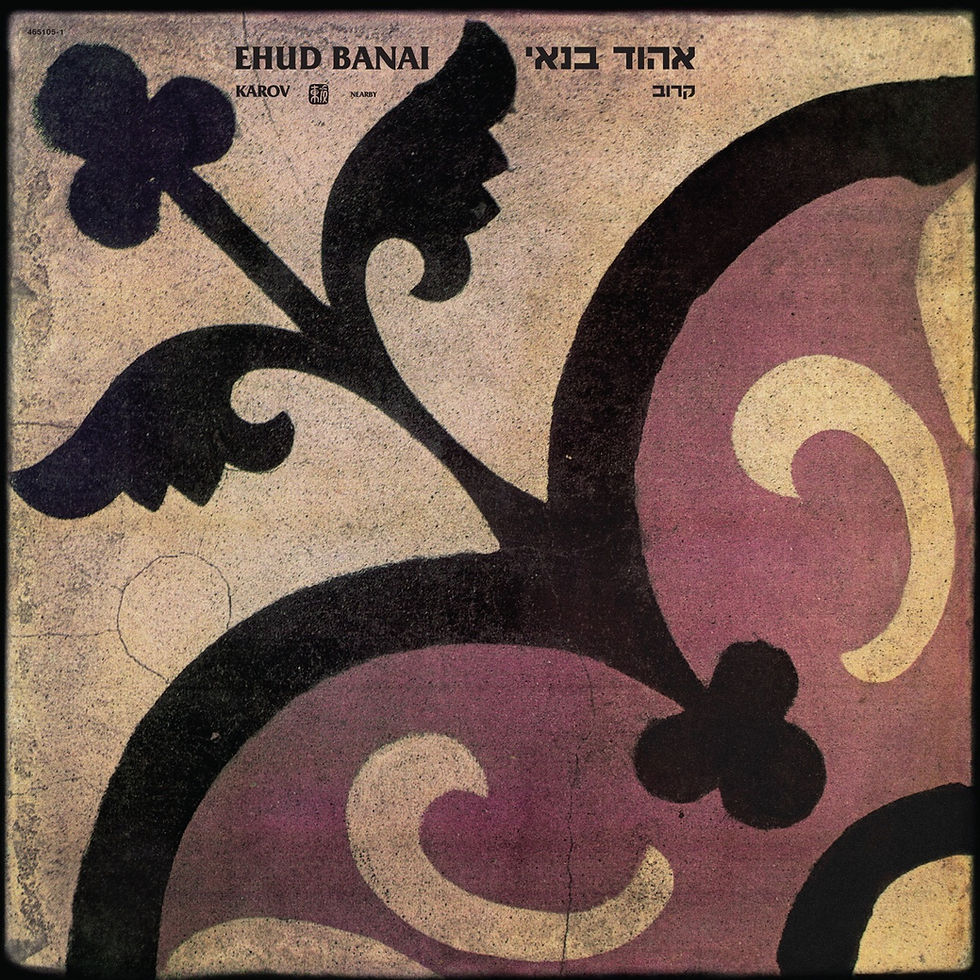
The cover, designed by Eitan Pimentel with photography by Daniel Hakim, belongs to this world too. Its photographed decorative motif, warm colors and worn, familiar-looking texture invite a closer look. There is no need for a portrait of the singer to sense how personal this album is.
Over the years, "Karov" achieved platinum status in Israel, and its songs became an integral part of Ehud Banai's live performances and his bond with his audience. A special colored-vinyl edition followed in 2024, marking its 35th anniversary. But one small story captures the album's journey better than sales figures: in a piece from 2007, Ehud Banai recalled waiting for a friend in Nazareth Illit sometime after its release and hearing "Karov" playing loudly from an apartment above him. He listened, deeply moved, and eventually went upstairs to knock on the door. Nobody answered. The person inside had no idea that the man who wrote the songs was standing outside.
Perhaps that is why the name "Karov", meaning "Close", fits so well. The album travels between countries, memories and musical styles, finding something personal and familiar wherever it goes. It holds the curiosity of someone who wants to keep traveling alongside an understanding of how precious the people and places we leave behind can be. And when it ends, it leaves us wanting to listen again, a little more closely.
For Listening: Spotify, Apple Music
"Face/Off" - Israel's Rock Blog


Comments