


Bullet for My Valentine - Venom

On August 14, 2015, "Bullet for My Valentine" released their fifth studio album "Venom".
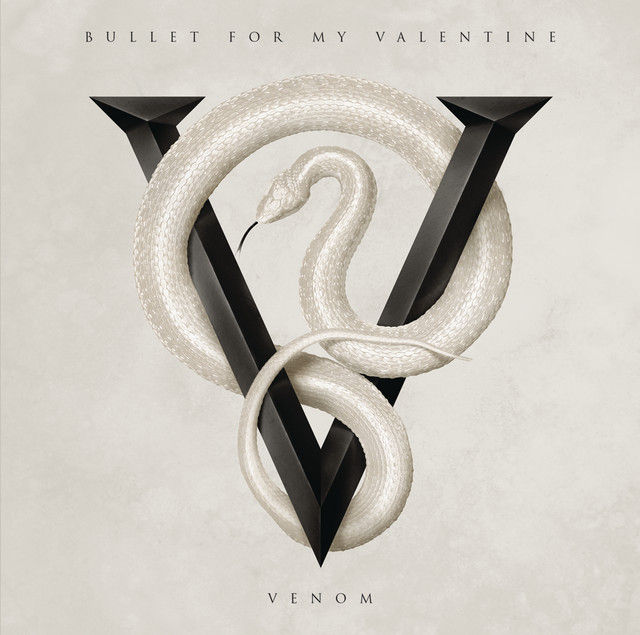
By 2015, "Bullet for My Valentine" had something to prove. Two years earlier, "Temper Temper" had pushed the Welsh band toward a cleaner and more accessible version of their sound, but its streamlined writing also removed some of the danger that had made their early records compelling. Lead guitarist Michael "Padge" Paget later described the objective behind "Venom" in uncomplicated terms: after "Temper Temper", they wanted a no holds barred heavy metal record, written without radio considerations dictating the outcome.
There was also instability inside the band. Longtime bassist Jason "Jay" James departed while the album was being made, with his exit announced in February 2015. Jamie Mathias was subsequently recruited and announced in May, although he did not actually play bass on the finished record. Vocalist and guitarist Matt Tuck handled the studio bass parts himself. "Venom" would also become the final "Bullet for My Valentine" album featuring founding drummer Michael "Moose" Thomas.
The writing process was more deliberate than usual. Tuck explained that riffs and lyrical ideas had accumulated during touring for "Temper Temper", before the band returned to the studio and began assembling them properly. Instead of taking six or seven finished songs into recording sessions and completing the rest along the way, they spent roughly six months longer on the material than they normally would, living with songs, rewriting them and discarding ideas that failed to hold up. That extra scrutiny matters because "Venom" rarely sounds like a collection of first impulses. It is aggressive, but the aggression has been engineered into compact songs with clear destinations.
Production reunited the band with Colin Richardson, working alongside Carl Bown. The album was recorded during 2014 and 2015 at Metropolis Studios in London, with Richardson and Bown also handling the mix at Treehouse Studio in Derbyshire. Their presence gives the record much of its physical force. The guitars are enormous without becoming shapeless, Thomas's drums retain their attack, and Tuck's clean vocals sit above the distortion without draining it of weight.
More importantly, Tuck had decided to dig back into darker lyrical territory. He described revisiting difficult places while writing the record and suggested that once he became comfortable putting those emotions into the songs, the material opened up dramatically. That decision is the real dividing line between "Venom" and its predecessor. This is not simply "Bullet for My Valentine" turning the distortion back up. It is a record built around confrontation, resentment, psychological pressure and release, and the heavier music gives those subjects an appropriate physical language.

The brief instrumental "V" functions less as a song than the sound of machinery starting. Then "No Way Out" arrives with exactly the violence the album needs. The riffing is clipped and muscular, Thomas drives the verses with restless momentum, and Tuck switches between screamed desperation and a huge melodic chorus. The structure is classic "Bullet for My Valentine": tension, eruption, melodic release, then back into the riff. What separates it from weaker examples of that formula is urgency. Nothing feels decorative.
"Army of Noise" makes the album's intentions even clearer. Paget and Tuck attack the main riff with a thrash informed precision, while Thomas pushes beneath them rather than merely keeping time. The chorus is deliberately oversized, but the guitars surrounding it remain abrasive enough to stop the track becoming arena metal by numbers. "Venom" repeatedly works because melody and aggression are treated as competing forces instead of mutually exclusive choices.
That balance is sharper on "Worthless". Its central riff has a blunt, percussive quality, and Tuck's vocal performance sounds genuinely hostile before the chorus opens into something cleaner and more immediately memorable. The transition should be predictable, and structurally it is, but the conviction sells it. "Bullet for My Valentine" have always lived on that fault line between metalcore violence and enormous choruses. Here they stop apologising for either side.
"You Want a Battle? (Here's a War)" is the album's most obvious crowd weapon, but it is also one of its smartest arrangements. The marching opening and group vocals establish scale before the guitars enter, then the song keeps moving between militant rhythm work and a chorus designed for thousands of voices. Its riff is simple compared with some of Paget's more technical playing, yet simplicity is the point. The song is about collective resistance, and everything in the arrangement is designed to sound larger than the individual musicians playing it.
The title track changes the temperature. "Venom" is more restrained and melodic, allowing Tuck's clean voice to carry the emotional weight while the guitars create pressure around him. Its subject, the lingering damage of a toxic relationship, gives the album title a meaning beyond simple metal imagery. The song's effectiveness comes from refusing to compete with the speed of the surrounding material. Instead, it tightens gradually, making the chorus feel wounded rather than merely catchy.
The second half is less immediate but contains some of the record's strongest musicianship. "The Harder the Heart (The Harder It Breaks)" uses a more spacious melodic approach before pushing into a muscular chorus, while "Skin" finds a particularly effective middle ground between the band's metalcore instincts and their polished songwriting. The guitars remain detailed without turning every transition into a technical exhibition.
Then "Hell or High Water" restores the record's sharper edge. The riffs have greater movement, the rhythm section feels less constrained by the verse and chorus template, and Paget's lead work reminds you that virtuosity has always been one of this band's advantages when it serves the song rather than interrupts it. "Pariah" closes the standard album with an appropriately hostile final surge, giving "Venom" an ending that feels like a conclusion rather than an exhausted collection of leftover riffs.
There are limitations. "Venom" is not a radical reinvention, despite Tuck's language at the time about reinventing the band. Its architecture remains recognisably "Bullet for My Valentine": precision riff, screamed verse, melodic chorus, breakdown, lead guitar release. At several points you can anticipate the shape of a song before it gets there. But predictability is less damaging when the execution is this committed. The band understood that their problem after "Temper Temper" was not an inability to write hooks. It was that those hooks had begun to arrive without sufficient danger around them.
"Venom" restores that danger. It does not attempt to recreate the youthful volatility of the band's earliest work, nor does it need to. Instead, it takes the melodic discipline accumulated over four albums and reconnects it with faster riffs, harsher vocals and a rhythm section allowed to hit with genuine force. Richardson and Bown give the record a modern, controlled surface, but underneath that polish the performances remain aggressive.
Listen to the album on: Spotify, Apple Music
"Face/Off" - Israel's Rock Blog


Comments