


Beck - Mellow Gold

Written By: Moti Kupfer
Release date - 01.03.1994
Sometimes we long for the moment when we could read the thoughts of the people around us, just for a second, just briefly, otherwise it would probably exhaust us.
Sometimes I feel that way about Beck. I would love to step inside his mind during his breakthrough year, 1994, the year he released three albums. In real time, only a handful of people bothered to truly listen to the creative explosion of Beck Hansen. One of those albums, Mellow Gold, was released on March 1, 1994.
In an interview, Beck said: “I chose the material that went onto the album randomly. Some of the recordings are embarrassing and some are better than I thought. Some of them I should have just burned.”
Beck compared the songs that did not make the record to airplanes on a runway, some of them waiting to take off and others that would never take off at all. He marveled at the many interesting territories his muse could have led him to.
Beck David Hansen was born on July 8, 1970, to a Christian father and a Jewish mother. He is better known by his stage name, Beck. Both of his parents came from musical backgrounds. His mother, Bibbe Hansen, worked as a musical director, singer, and actress, and in her youth appeared in several films by Andy Warhol.
Beck’s father, David Campbell, is a composer, arranger, and conductor. Beck noted that while growing up he “celebrated Jewish holidays” and that he considers himself Jewish. His father worked with artists such as Carole King, "Green Day", and "Aerosmith", and also collaborated with Beck on several of his songs. Beck’s grandfather was Al Hansen, a visual collage artist. After his parents divorced, Beck adopted his mother’s surname.
As a teenager, he was heavily influenced by the music around him and began playing acoustic guitar at a very young age. At 16, he dropped out of high school and moved to New York City. There, in his early twenties, he became active in the anti-folk movement, a scene that blended the sound of 1960s American folk with punk aesthetics.
“The whole idea was to eliminate all the old cliches, and invent some new ones,” Beck said about his years in New York. “Everybody knew each other. You could get up on stage and say anything, there was no pressure, and nobody made anybody feel weird.”
Inspired by that freedom, Beck began writing freely associative, surreal songs about pizza, MTV, and working at McDonald’s.
He started performing on city buses, often creating covers of blues artist Mississippi John Hurt alongside original compositions, sometimes simply improvising.
In the early 1990s, Beck decided to return to Los Angeles. He worked a variety of odd jobs while trying to perform in clubs around the city. Sometimes he would sneak onto the stage and play a few songs while the scheduled band was still setting up their equipment.
Eventually, Beck caught the attention of Margaret Mittleman from "BMG Music", as well as the partners behind the independent label Bong Load Custom Records: Tom Rothrock, Rob Schnapf, and Brad Lambert.
Rothrock introduced him to Carl Stephenson, a record producer for Rap-A-Lot Records. In 1992, Beck visited Stephenson’s home to collaborate. The result of that meeting was the hip hop song Loser, released as a single in 1993.
The single became an unexpected hit on American radio. As a result, major record labels began chasing Beck, who eventually decided to sign with Geffen Records. His contract with Geffen was unique in that it allowed him to continue recording and releasing albums through other labels as well.
The song is built around a sampled drum break, a looped sample of Beck playing guitar, and live sitar performed by Carl Stephenson. Beck delivers deliberately laid back rap verses and a chorus that would soon become iconic. He later explained: “I wanted to emphasize how weak I was at rapping, and that’s where the next line came from, ‘I’m a loser baby, so why don’t you kill me.’”
The track evolved into a kind of ethos for 1990s music, closely associated with what became known as slacker culture, a term used to describe young people perceived as apathetic, cynical, unambitious, or detached from traditional expectations of work and commitment.
"Mellow Gold" is a glorious hybrid of rock, lo fi country, hip hop, folk, blues, and psychedelia, wrapped in surreal lyrics. That combination created a fascinating mix of sounds, samples, and textures, all held together by truly remarkable songwriting.
It is such a diverse and ambitious album that it could be considered a pop record you can play to lo fi fans, a hip hop album you can play to country fans, and an avant garde noise experiment you can play to hip hop heads.
At its core, this is a work of art about jobs: working them, losing them, the cyclical ruin that comes from failing to get one, and the capitalist pressure placed on those who cling to their jobs with everything they have.
Even when work is not directly in the picture, poverty defines the frame. The stories of "Mellow Gold" unfold in trailer parks, surviving on credit and cases of cheap beer. The music sounds like trash because trash is what he sees outside his window. And that is really the punchline of "Loser." He did not lose. He simply never had a chance to begin with.
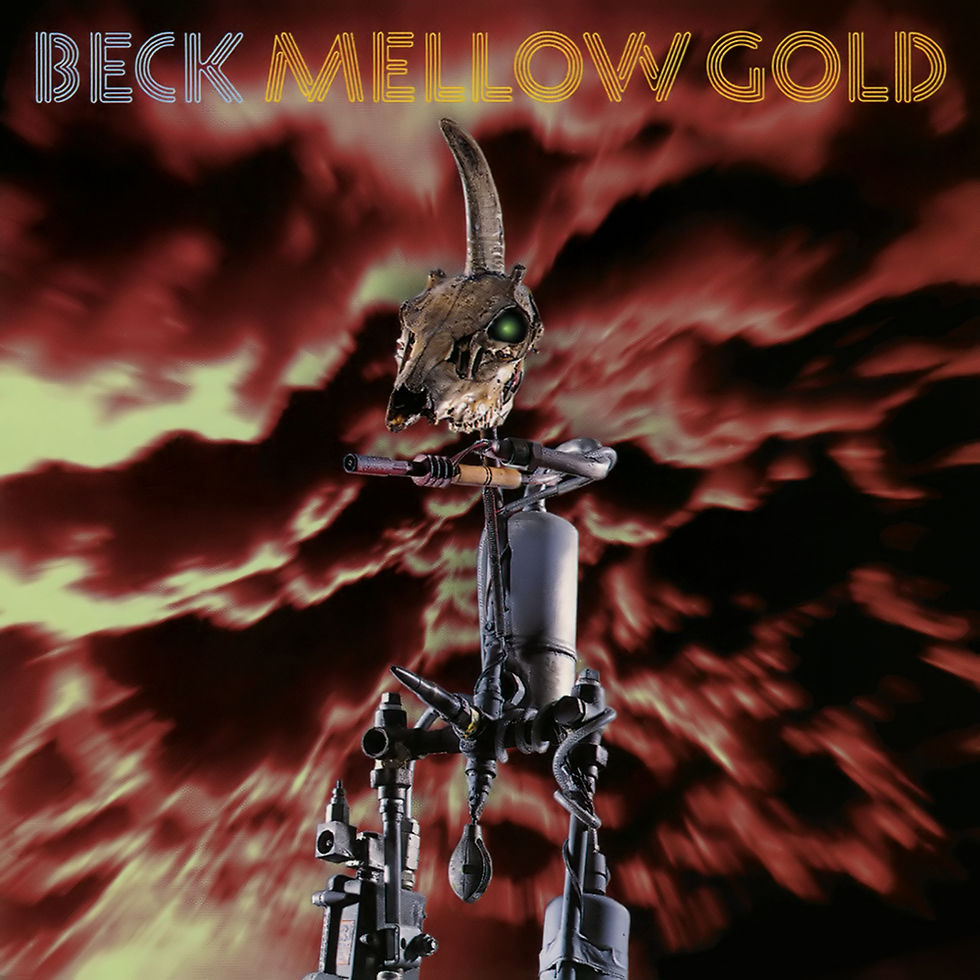
The robot on the cover of "Mellow Gold" was created by artist Eddie Lopez, who also made a brief appearance in the video for "Loser." The sculpture was titled “Nuclear Bomb Survivor.” The photograph was originally taken in Lopez’s garage studio by Beck’s friend Ross Harris. The album was initially intended to be called “Cold Ass Fashion,” sharing its name with an earlier Beck song, but was ultimately titled "Mellow Gold", after a potent strain of California marijuana.
For Listening: Spotify, Apple Music
Comments